PAM Academy Hub

Privileged Access Management Training

A vendor-neutral PAM course and career pathway.

Your PAM career path.

PAM industry-relevant curriculum.

Certification & Career support.

Frequently Asked Questions.
A vendor-neutral, holistic PAM curriculum — built in the classroom, proven in industry.

From university teaching to a practical PAM curriculum

PAM Best Practice began with guest lecturing on Privileged Access Management at university level. That teaching revealed a gap that runs right through the industry: PAM is one of the most critical disciplines in cybersecurity, yet it is barely taught, rarely structured, and almost never approached in a vendor-neutral way.

We built the curriculum that did not exist — a structured, nine-module programme that takes you from first principles to a working PAM strategy.

The Periodic Table of PAM Security

Every module maps to the Periodic Table of PAM Security — our framework of 81 elements across eight categories, from foundational access controls to non-human identities, just-in-time access and cloud-native PAM. It gives you a complete, structured map of the discipline rather than a vendor's feature list.

Ask about the interactive Periodic Table of PAM Security →
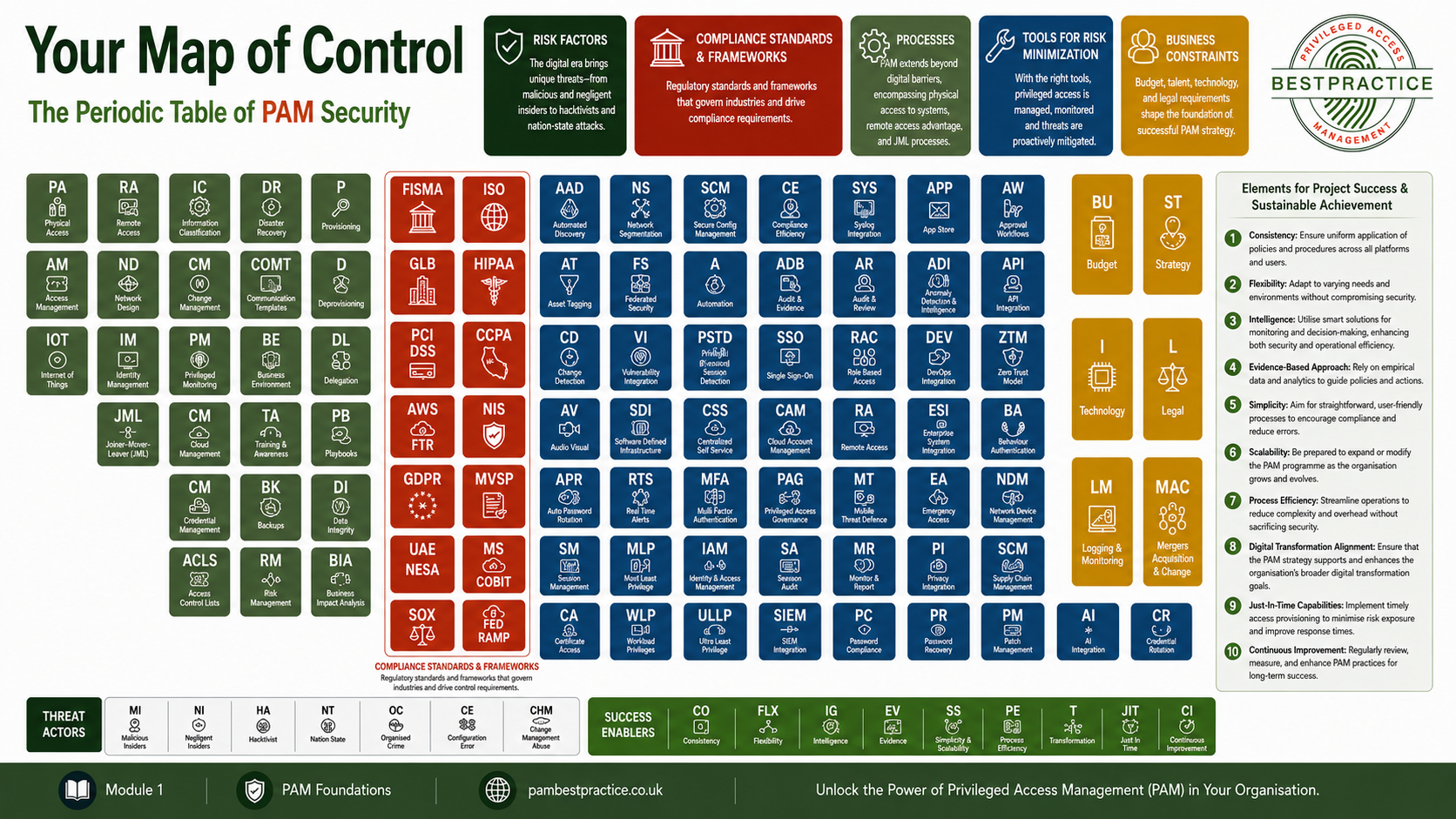
The Periodic Table of PAM Security framework

Who this PAM course is for

Whether you are developing a PAM career, improving capability inside a security team, or embedding PAM into education, this course gives each audience a clear route into practical privileged access management.

Security and IT teams

Analysts, engineers, architects and administrators who need to design, run and audit privileged access in real environments.

Learn how privileged access exists across cloud, on-premise, applications, endpoints and non-human identities.

Build a shared language for PAM strategy, controls, monitoring and audit readiness.

Individuals building a PAM career

For people moving into cybersecurity who want a structured, recognised grounding in a high-demand specialism.

Understand PAM from first principles rather than through a single vendor tool.

Develop vocabulary, examples and evidence you can use in interviews and workplace conversations.

Connect learning to realistic roles across security operations, identity, infrastructure and governance.

Educators and institutions

For colleges and universities embedding PAM into cybersecurity, computing and IT programmes.

Use a structured, vendor-neutral curriculum that supports employability.

Map learning to a clear PAM framework rather than disconnected security topics.

Explore business and university collaboration →

How the course works

Self-paced online learning that helps each audience build confidence from foundational PAM concepts through to applied strategy and maturity.

Progress through structured modules mapped to the PAM curriculum.

Use practical examples, frameworks and templates to connect learning with real operating environments.

Ask about PAM training →

Course modules

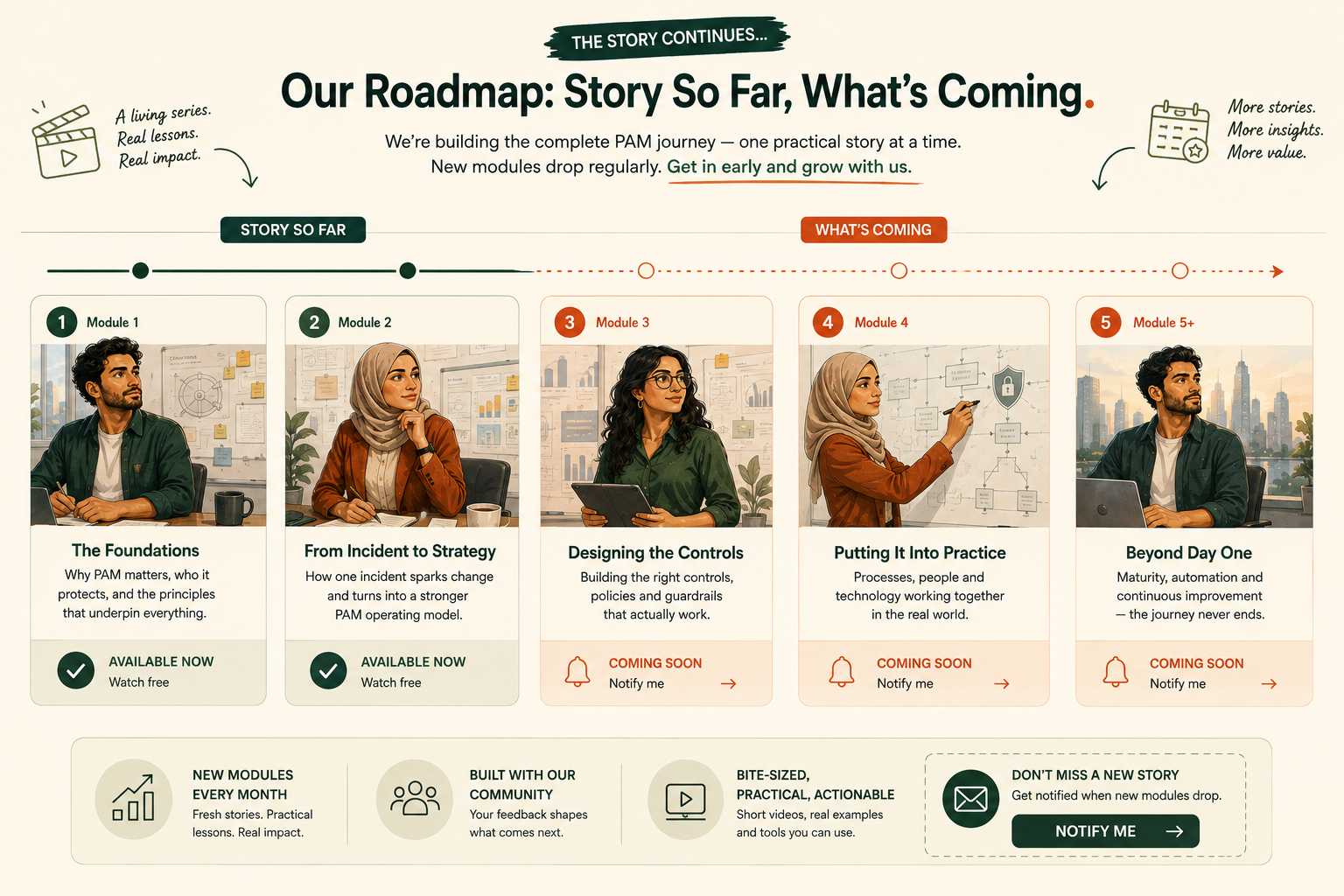
Explore the nine-module PAM curriculum and how it maps to the Periodic Table of PAM Security.

We have partnered with specialist tech recruiters who support graduates with CV preparation, interview practice and introductions to employers.

Learning outcomes

Practical outcomes for learners, teams and partner institutions.

PAM Academy learning outcome icon

Build practitioner skills

Learn the concepts, policies, strategies and tools used to protect privileged assets and users across an organisation.
PAM Academy learning outcome icon

Earn a recognised credential

Gain a certificate that evidences your PAM knowledge and practical learning to employers.
PAM Academy learning outcome icon

Apply it immediately

Every module is built around real scenarios and the templates practitioners actually use.
PAM Academy learning outcome icon

Join a professional network

Access workshops, mentoring and best-practice sessions with practising PAM professionals.

Frequently asked questions

Common questions about the PAM Academy course.

1How is the course delivered?
Online and self-paced, with optional in-person workshops. It can also be delivered on campus through partner institutions.
2Who can take it?
Anyone wanting to learn PAM. It is free for learners in full-time education whose institution is a registered partner, and available to individuals and organisations otherwise.
3What will I gain?
A certificate of completion, access to a network of PAM practitioners, and — through partner institutions — the potential for additional academic credit.
4How much does it cost?
Free for learners at registered partner institutions. Individual and organisational pricing is shown per module, with discounts for multiple seats.
5How long does it take?
Self-paced, 25+ hours of content. Most learners complete it over several weeks.