
The PAM Academy · Module 2
Most privileged access problems are discovered the same way: an incident happens, someone pulls the logs, and the investigation turns into an inventory. A forgotten service account becomes forty-seven orphaned accounts. One over-privileged engineer becomes eighty-nine over-privileged users. The account that caused the incident was never the exception. It was the pattern.
At that point the organisation faces a choice. It can buy a privileged access management tool, install it, and declare the problem solved. Or it can accept the harder truth that no process caught the forgotten account, no review flagged the excess access, and no named person owned the decision in the first place. A tool does not fix any of those things. A programme does.
This module is about building that programme: the strategy that sets direction, the operating model that assigns ownership, the processes that move the work, the controls that enforce it, the technology that makes it stick, and the maturity model that tells you whether any of it is working. It is written for the person who has just been handed the aftermath of an incident and asked to make sure it does not happen again.
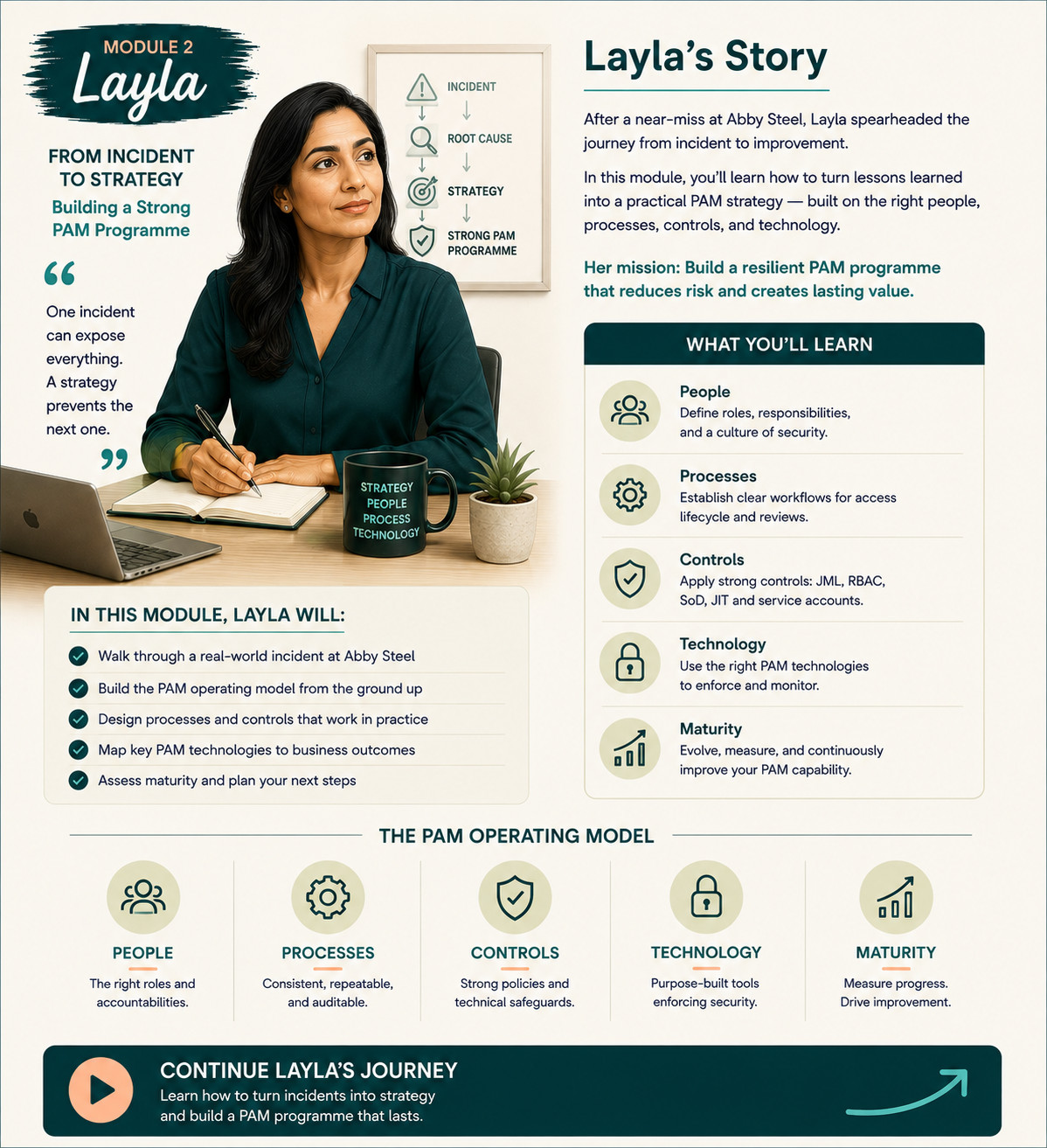
Module 2: Layla, PAM Programme Lead and Executive Sponsor
Part of the PAM Academy. Every module follows one person through a real privileged access problem, so the lesson lands in the context of the job you actually do.
Who this module is for
CISO or Head of Security
A board-ready way to present privileged access as a programme with owners, metrics and a funded roadmap, rather than as a tool purchase that ends when the invoice is paid.
IAM Engineer
A clear picture of how strategy, ownership and process should sit above the technology you are asked to configure, so the platform enforces decisions someone has actually made.
Security Architect
The five core controls, where each one belongs in the access lifecycle, and how to design them so they are strong without being routinely bypassed.
IT Operations Lead
Workable joiner, mover and leaver workflows, a five-step access request process and a staged automation plan that does not break the service desk on day one.
GRC or Compliance Manager
How to map privileged access controls to GDPR, SOX, PCI DSS and HIPAA obligations, and how to evidence recertification and audit trails when a regulator asks.
The problems this module solves
Everyone touches privileged access, nobody owns it
IT provisions accounts but does not decide who deserves them. Security investigates incidents but does not control the access that causes them. The business requests access but never reviews it. With no single accountable owner, every improvement stalls at the first disagreement and nothing is ever formally retired.
The tool arrives before the strategy
Organisations routinely run the sequence backwards, buying a platform and only then discovering there are no processes to automate, no owners to approve requests and no measurable goals to report against. The technology works and the programme still fails, usually reappearing later as a rebuild at considerably higher cost.
Access accumulates and never decays
Privilege granted for a project outlives the project. Role changes add new access without removing the old. Leavers keep logins for weeks. Without recertification and an enforced leaver timeline, the estate quietly fills with credentials that have no living owner and no business justification.
Controls are introduced without change management
A control that lands with no explanation, no training and no channel for concerns is a control that gets escalated, worked around or switched off. One healthcare organisation launched privileged access controls with minimal communication, locked clinicians out of systems essential for patient care, and had to pause and restart the whole rollout.
What you will learn
- People: define roles, responsibilities and a culture of securityName a single accountable sponsor and split the chain of custody so that the business approves access, security reviews it and IT provisions it. Build the communication and training plan that turns a control into a habit.
- Processes: establish clear workflows for the access lifecycle and reviewsRun a five-step access request process, a same-day leaver timeline and quarterly recertification, all wrapped in a joiner, mover, leaver lifecycle that covers every identity from first day to last.
- Controls: apply least privilege, RBAC, segregation of duties, JIT and service account controlsDeploy the five enforcement controls and extend them to the accounts most programmes miss: machine identities, third-party access and break-glass credentials.
- Technology: use the right PAM technologies to enforce and monitorMap vaulting, credential rotation, just-in-time elevation, session recording, multi-factor authentication and HR-triggered lifecycle automation to the specific business risk each one reduces.
- Maturity: evolve, measure and continuously improve your PAM capabilityPlace your organisation on the five-stage maturity model, agree the metrics that prove progress, and sequence a twelve-month roadmap that moves from visibility to control to automation to governance.
How do you turn a security incident into a PAM programme?
A privileged access incident is expensive, but it is also the only moment when an organisation will fund work it has deferred for years. The task in the first fortnight is to convert the incident into evidence, and the evidence into a mandate.
Start by reconstructing what happened and then deliberately widening the question. If one forgotten service account provided the way in, the next question is not who forgot it but how many more are there. That widening is what turns an incident report into an inventory. In the case study behind this module, a week of investigation surfaced forty-seven orphaned accounts with no living owner and eighty-nine users holding far more privilege than their jobs required, with a note attached warning that a week of searching had barely started.
Then name the root cause honestly. Blaming an individual produces a disciplinary outcome and no structural change. The finding that actually funds a programme is that no process caught the account, no review flagged the excess access, and no owner existed to ask. Fix the person and you fix one case. Fix the system and you fix it for everyone.
Finally, frame the ask correctly. A tool gets installed and forgotten. A project ends and its owners move on. A programme has strategy, ownership, processes, controls and a maturity path that keeps running after the incident stops being news. Put that distinction in the first sentence of the board paper, because it is the sentence that stops the conversation becoming a two-week product demonstration.
- Reconstruct the incident, then widen the search to the whole account population.
- Report the control failure, not the individual.
- Ask for a programme with a sponsor and a budget line, not a purchase.
- Capture the numbers you found now, because they become your baseline metrics later.
What is a PAM strategy, and what belongs in it?
A PAM strategy answers four questions, and the order matters more than the content. What are we protecting and why? That is strategy. Who does what? That is the operating model. How does work flow? Those are the processes. Only then: what technology enforces it all? Most organisations run this backwards and pay for it twice.
A workable strategy fits on a single page and rests on five pillars.
- Visibility. Know every privileged account, every owner and every entitlement. You cannot protect what you cannot see.
- Control. Least privilege, role-based access and multi-factor authentication enforced everywhere privilege lives.
- Governance. Clear ownership, regular reviews and policies people will actually follow.
- Automation. Lifecycle events handled by workflow rather than by memory, because memory is what forgets service accounts.
- Audit. Every privileged action recorded and every control provable to any regulator who asks.
A strategy that only speaks security will not survive its first budget round, so anchor it to two things the business already cares about. The first is business risk: protect most where the organisation bleeds most, which usually means production systems where downtime costs money by the minute, finance systems where a compromised account means fraud, and HR systems where a breach exposes personal data at scale. The second is compliance: GDPR, where weak access controls can turn into fines of up to four percent of global turnover; SOX, which demands segregation of duties in anything touching financial reporting; PCI DSS for payment data; and HIPAA wherever health information lives.
Before approval, walk the draft round the functions that could kill it in month six. One retailer let IT choose a privileged access solution unilaterally; after launch, finance could not reach the systems it needed for reporting and store operations seized up behind approval bottlenecks. The technology worked and the programme had to be rebuilt at twice the cost.
How do you build a PAM operating model and decide who owns access?
Strategy says what and why. The operating model says who and how, and it is the part that breaks more programmes than any technology ever has. The question it must answer in one line is: who owns access?
Think in three overlapping circles. IT is the hands: it provisions, configures and operates. Security is the eyes: it sets policy, reviews access and monitors for abuse. The business is the judgement: it decides who needs access to its own systems and answers for those decisions. Where the circles overlap is where privileged access management actually happens. As Kevin Stine of NIST has put it, technology offers the tools, but it is the people who execute and the processes they follow that solidify the foundation of any security framework.
Translate that into a chain of custody built deliberately on segregation of duties, so that no single person controls the whole chain:
- The business owner approves. They know the job, so they judge the need.
- Security reviews. Every grant is checked against policy and least privilege.
- IT provisions. It implements what was approved, and nothing it was not asked to.
The reason for splitting the chain is not bureaucracy. In 2008 a trader at Société Générale who had moved from the back office to the trading floor retained both perspectives and used them to conceal unauthorised trades, contributing to losses of around 4.9 billion euros. One person, both sides of the process, no segregation.
Above the chain, name a single accountable sponsor who owns the strategy, the budget and the outcomes, and who reports to the board. Below it, be explicit that security owns policy and oversight, IT owns implementation and operations, and business owners own the access decisions for their own systems. Access is owned by the business, managed by IT and overseen by security. Three hands on every key.
Which processes does a PAM programme need?
An operating model that is not expressed as workflow is just a diagram. Four processes carry almost all of the risk.
Access request. Five steps, every time: request with a written business justification, approve by the business owner, review by security against policy, provision by IT, and record so that every step is documented and trackable. Skipping this discipline is how a misconfigured provisioning process at the US Department of Veterans Affairs allowed an unauthorised user to create a new account with system administrator privileges and reach veterans’ personal records.
Recertification. Access decays, so the process cannot end at provisioning. Every quarter, business owners review the access their people hold. Still needed, it stays. Not needed, it goes. A single review cycle is usually what would have removed a forgotten service account years before an attacker ever found it.
Leaver and deprovisioning. Four beats with no gaps: the HR system fires the trigger automatically on the day someone leaves, the manager confirms the full list of systems, IT removes every credential including service accounts and shared logins that hide outside the obvious list, and security verifies independently, because the team that removes access should not be the team that marks its own homework. Buffer was breached through a former employee’s account that was never deactivated after they left.
Joiner, mover, leaver. The leaver process is only a third of the lifecycle. The step organisations forget is the mover: when someone changes role, the old access has to die with the old job. Skipping it is exactly how a long-serving engineer accumulates twelve years of privilege. Get the lifecycle wrong at scale and you get Uber in 2016, where credentials that should no longer have worked exposed the personal data of fifty-seven million customers and drivers.
Automate this in stages: manual but controlled, then documented, then partially automated, then fully automated with humans handling only exceptions and approvals. Automating a broken process does not fix it, it just makes it fail faster and at scale.
What are the five PAM controls, and which accounts do programmes miss?
A control is not a guideline or a best effort. It is a rule the system itself enforces whether or not anyone remembers it exists. Five controls do the enforcement work.
- Least privilege. Every user and process gets the minimum access the job requires. If one account is compromised, the attacker gets one room rather than the building.
- Role-based access control. Permissions attach to roles and people attach to roles, which makes access consistent, scalable and auditable in minutes. Watch for role explosion, where hundreds of hyper-specific roles recreate the chaos you were escaping, and role creep, where permissions are quietly added until the role holds far more than intended.
- Segregation of duties. No single person can approve and execute a critical action, and the most dangerous operations require two authorised people at the same moment.
- Just-in-time access. Nobody holds administrative rights permanently. Elevation is requested for a task, granted for a window and expires automatically. A stolen credential that carries no standing privilege is a key to a lock that no longer exists.
- Multi-factor authentication. Something you know, something you have, something you are, with no exceptions for privileged access. Attackers entered Colonial Pipeline in May 2021 through a dormant VPN account protected by a password alone, shutting down five and a half thousand miles of fuel pipeline.
Three categories of account sit outside most programmes and deserve explicit scope. Machine identities, meaning service accounts, scripts and bots, now outnumber human identities many times over, with industry studies putting the ratio above forty to one. They do not answer MFA prompts and their passwords often have not changed in years, so vault them, rotate them, give each one a named human owner and include them in every review. Third-party access extends your perimeter to every supplier you have given a login; attackers reached Target in 2013 through credentials stolen from its air-conditioning contractor, ending in around forty million payment cards. Break-glass accounts cannot be deleted, because a crisis with no way in is a longer crisis, but they should be sealed, checked out under two-person control, alarmed on use and rotated on return.
One design rule sits above all five: a control that is too cumbersome gets bypassed, and a bypassed control is worse than none because it creates false confidence. Good controls are strong and smooth.
Which PAM technologies do you need, and how do you measure maturity?
Technology comes last in the sequence and first in most budgets. Choose it by the outcome it delivers rather than by feature count.
Mapping technology to business outcomes
- Credential vaulting and rotation. Removes shared passwords from spreadsheets and gives every service account an owner, a rotation schedule and an audit trail.
- Just-in-time elevation. Eliminates standing privilege so a stolen credential carries no rights by default.
- Session recording and monitoring. Makes privileged activity reviewable after the fact and evidences the audit pillar to regulators.
- Multi-factor authentication on privileged paths. Stops the most common intrusion route, the valid login.
- Lifecycle integration with HR and IAM. Fires joiner, mover and leaver workflows automatically so revocation never waits for a manager to remember on a busy Friday.
- Discovery and reporting. Finds accounts nobody declared and produces the recertification and coverage reports the board will ask for.
Measuring maturity and sequencing the roadmap
Maturity has five stages: chaos, where accounts are unknown and privilege unmanaged; visibility, where you can see the problem even if you cannot yet stop it; control, where least privilege, RBAC, MFA and defined processes are actively enforced; automation, where the lifecycle runs itself; and governance, where continuous review and measurable risk reduction make the programme improve itself.
Most organisations sit in stage one or two. Industry figures cited in this module put the scale of it plainly: 73 percent lack visibility into privileged access, 68 percent have over-permissioned users, 82 percent do not review access regularly and 91 percent lack formal PAM governance.
A twelve-month roadmap in four phases moves an organisation from chaos to control and beyond: months one to three complete discovery of every privileged account; months four to six extend the five controls to every system in scope; months seven to nine wire the lifecycle to the HR system; months ten to twelve establish continuous reviews and board-level reporting. Track progress against hard measures: full discovery and ownership of privileged accounts, recertification running monthly rather than annually, incidents contained in under an hour, and unauthorised privilege use at zero. On why containment speed matters, IBM’s 2024 study found breaches involving stolen credentials took an average of 292 days to identify and contain.
Layla’s story
Layla arrived at Abby Steel on the Monday after the incident with the alerts still on her screen and the board’s instruction still ringing: secure access, reduce risk, drive trust. She had not caused the crisis, but she owned the fix. The reconstruction showed three systems compromised through one forgotten service account. Then a senior security analyst, Priya, kept digging and the incident became an inventory: forty-seven orphaned accounts, eighty-nine over-privileged users, and a handwritten note saying that a single week of searching would not be the end of it.
Mapping the organisation chart, Layla found the real fault. Everyone touched privileged access and nobody owned it. She took a programme to leadership rather than a product, walked the draft strategy through finance, HR, operations and the plant managers first, and got approval in a twenty-minute board meeting. Six months later Abby Steel had moved from chaos to control, and the same engineers were still doing the same work inside a framework that no longer depended on anyone’s memory.
Common mistakes to avoid
Buying the tool before writing the strategy
A platform bought first has no processes to automate, no owners to approve requests and no goals to measure against. Answer what you are protecting, who decides and how work flows, then choose technology to enforce those answers.
Automating a broken process
Automation applied to an undefined workflow makes it fail faster and at scale, with an audit trail proving you knew. Run the process manually but controlled, document it, then automate the high-volume, low-judgement steps first.
Leaving the mover step out of the lifecycle
Organisations build joiner and leaver workflows and skip role changes, which is precisely how a competent long-serving employee ends up holding a decade of accumulated privilege. Treat a role change as a leaver from the old role and a joiner to the new one.
Scoping only human accounts
Service accounts, vendor logins and break-glass credentials are where privilege hides, and machine identities now outnumber human ones many times over. Give every one of them a named owner, a rotation schedule, an expiry and a place in the review cycle.
Rolling out controls without change management
Controls introduced with no explanation, training or feedback channel get escalated, worked around or paused, as one healthcare organisation found when clinicians were locked out of care systems on day one. Communicate the rationale, train before go-live and publicise early wins.
Key takeaways
- Strategy comes before tools, always: what you protect, who decides, how work flows, then what enforces it.
- Name one accountable sponsor and split approval, review and provisioning across three parties so nobody controls the whole chain.
- Access decays, so recertification and a same-day leaver timeline matter more than any single technology.
- Five controls do the enforcing: least privilege, RBAC, segregation of duties, just-in-time access and multi-factor authentication.
- A control that is too cumbersome gets bypassed, and a bypassed control is worse than none because it creates false confidence.
Frequently asked questions
How do you build a PAM programme from scratch?
Work in sequence rather than in parallel. Define a strategy that states what you are protecting and why, usually as a small set of pillars covering visibility, control, governance, automation and audit. Build an operating model that names a single accountable sponsor and separates approval, review and provisioning. Write the processes that move the work, meaning access requests, recertification and the joiner, mover, leaver lifecycle. Deploy the five enforcement controls. Only then select technology, chosen by the outcome each capability delivers. Finally, agree the metrics and the maturity stages you will report against, so the programme keeps running once the incident that funded it is forgotten.
What is a PAM operating model?
A PAM operating model defines who does what across privileged access, and it exists to remove the ambiguity that lets accounts go unowned. The usual shape has three parties. The business owner approves access because they understand the job and can judge the need. Security reviews the request against policy and least privilege. IT provisions exactly what was approved and nothing more. Above them sits a single accountable sponsor who owns the strategy, the budget and the reporting to the board. The split is deliberate segregation of duties: no individual should be able to request, approve and implement their own privilege.
How long does it take to implement privileged access management?
Plan for twelve months to reach a governed state, with visible progress far sooner. A practical roadmap runs in four phases: months one to three on discovery, so every privileged account is found, classified and owned; months four to six on control, extending least privilege, RBAC, segregation of duties, just-in-time access and MFA across systems in scope; months seven to nine on automation, connecting the lifecycle to HR and identity systems; and months ten to twelve on governance, with continuous reviews and board-level reporting. Moving from chaos to enforced control within about six months is a realistic target for a well-sponsored programme.
Who should own privileged access management in an organisation?
Ownership should be explicit at two levels. One named sponsor, typically a security or IAM leader with board access, is accountable for the strategy, budget and outcomes. Beneath that, responsibility is shared by design: security owns policy and oversight, IT owns implementation and operations, and business owners own the access decisions for their own systems because only they know who genuinely needs what. The failure pattern to avoid is the one most organisations start from, where IT provisions without deciding, security investigates without controlling, and the business requests without ever reviewing. Everyone touches privileged access and nobody owns it.
What should you do after a privileged access incident?
Treat the incident as the start of an inventory rather than the end of an investigation. Reconstruct the entry path, then widen the question from how this account was missed to how many similar accounts exist, and record the numbers because they become your baseline. Identify the control failures rather than the individual: the review that never ran, the process that never triggered, the owner who was never assigned. Then convert the findings into a funded programme with a sponsor, a strategy, defined processes, enforcement controls and measurable goals. An incident buys attention and budget for a short window, so use it to fix the system rather than the symptom.
Start Module 2 in the PAM Portal
Work through Layla’s module in full, with the walkthroughs, templates and assessment that turn this into something you can apply on Monday morning.
Open Module 2 in the PAM Portal
Vendor-neutral. Built by practitioners. Designed around the roles that do the work.