
The PAM Academy · Module 1
Most organisations cannot answer a simple question: who holds administrative access to our most important systems, and why do they still have it? Privileged accounts sit above normal controls. They can change configuration, read any record, switch off logging and hand more access to someone else. When one is forgotten, shared, or left behind by a person who moved on, it becomes the quietest way into the business.
This is not a rare failure. The same pattern shows up across industries: privileged access nobody can fully see, users holding more access than the job needs, reviews that do not happen and no formal PAM governance. Meanwhile IBM’s 2024 study puts the average cost of a data breach at $4.88m, and breaches involving stolen credentials take an average of 292 days to identify and contain. That is close to ten months of an attacker inside before anyone closes the door.
This page is the entry point of the PAM Academy course and a standalone briefing for anyone who has to explain, fund or sponsor a privileged access management programme. It covers what PAM actually is, why privileged access belongs on the board agenda, the principles every successful programme rests on, and how to make the case in language the business already understands.
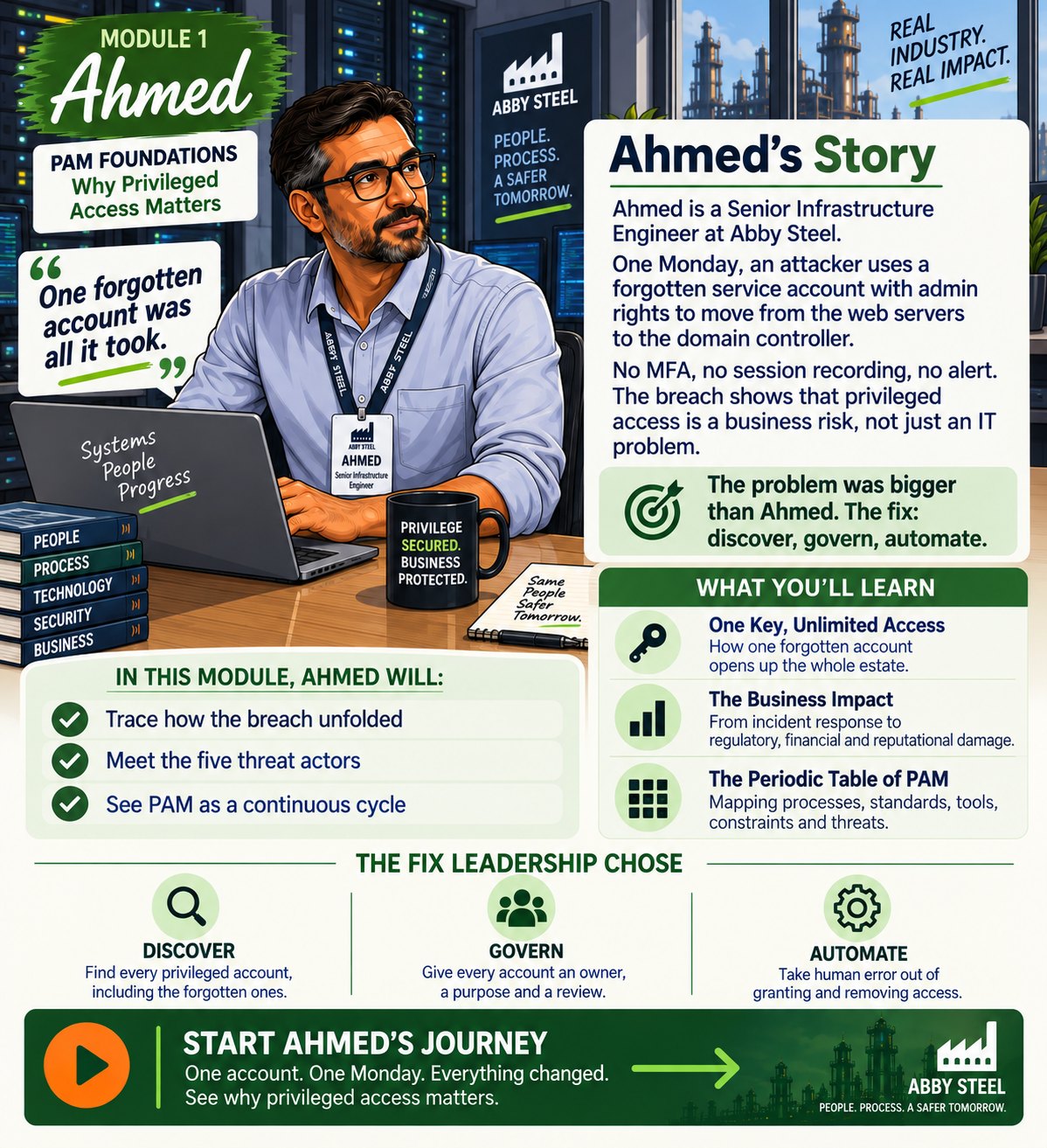
Module 1: Ahmed, Senior Infrastructure Engineer
PAM Foundations · “It Started on a Monday”. A forgotten service account lets an attacker into Abby Steel, showing why unmanaged privileged access is a business risk, not just an IT one. Part of the PAM Academy, where every module follows one person through a real privileged access problem. Open Module 1 in the PAM Academy →
Who this module is for
CISO or Head of Security
A board-ready articulation of privileged access risk, with the figures, the failure patterns and the success metrics that keep a programme funded past year one.
CIO or IT Director
Clarity on why PAM is an operating model change rather than a product purchase, and an honest view of what it will ask of IT teams day to day.
Executive sponsor or board member
Enough grounding to challenge a PAM proposal properly: what it protects, what it enables, what it proves, and what happens if it is deferred again.
GRC and compliance manager
How privileged access controls connect to GDPR, SOX, PCI DSS and HIPAA obligations, and what evidence auditors and insurers now expect to see.
IAM engineer or security architect
The strategic reasoning behind the controls they build, so design decisions can be justified upwards instead of defended in isolation.
The problems this module solves
Everyone touches privileged access, nobody owns it
IT provisions accounts but does not decide who deserves them. Security investigates incidents but does not control the access that caused them. The business requests access and then never reviews it. With accountability spread this thinly, a forgotten privileged account can survive for years because there is no single person whose job it is to notice.
Privilege only ever grows
Access is granted quickly and removed slowly, if at all. People change teams and keep the rights from the last role. Projects finish and their service accounts keep working. Over a decade this leaves a long tail of standing privilege that nobody requested, nobody reviews and nobody can justify when an auditor asks.
PAM gets bought as a tool and fails as a programme
A product is procured, deployed and then treated as done. A major retail organisation let its IT department choose a PAM solution unilaterally. After launch, finance could not reach the systems it needed for reporting and store operations seized up behind approval bottlenecks. The technology worked. The programme had to be rebuilt at twice the cost.
The case is made in security language the board does not buy
A strategy that only speaks security dies in the boardroom. Vault counts, session recording and least privilege mean little to a finance director. Until privileged access risk is expressed as downtime, fraud exposure, regulatory penalty and insurability, PAM competes for budget on someone else’s terms and loses.
What you will learn
- The forgotten accountExplain how one forgotten privileged account can give an attacker access across an entire environment.
- The business impactDescribe the business impact of a privileged access breach, from incident response to regulatory, financial and reputational damage.
- PAM as a cycleOutline privileged access management as a continuous cycle: discover, request, approve, monitor, review and revoke.
- The five threat actorsRecognise the five threat actors and why every one of them depends on uncontrolled access.
- The Periodic Table of PAMUse the Periodic Table of PAM Security to map processes, compliance standards, tools, business constraints and threats.
Why is privileged access management important?
Privileged access is the concentrated form of every risk an organisation carries in its technology estate. One privileged credential can move money, expose personal data, halt production or erase the evidence that any of it happened. Ordinary user access is a door into a room. Privileged access is a master key to the building, and most organisations issued far more of them than they can now account for.
The reason this has become urgent is that attacker behaviour changed. The modern intrusion rarely begins with breaking a firewall. It begins with a valid login: stolen credentials, a phished session, or access bought from a broker. The industry phrase for it is that attackers do not break in any more, they log in. That makes identity the effective perimeter, and privileged identity its most valuable gate.
The public cases follow the same shape:
- Colonial Pipeline, May 2021. Attackers entered through a single dormant VPN account protected by a password alone, with no second factor. The result was 5,500 miles of fuel pipeline shut down, fuel shortages across the American East Coast and a multi-million dollar ransom.
- Buffer. A hacker reached a database of customer data, including emails, passwords and social media access tokens, through a former employee’s account that was never deactivated after they left. The person moved on. The access did not.
- Uber, 2016. Hackers reached the personal data of 57 million customers and drivers through credentials that should no longer have worked, access that was not properly deactivated or monitored. The subsequent cover-up multiplied the penalties into the hundreds of millions.
None of these started with an exploit. Each started with a credential that outlived its purpose. That is precisely the risk PAM exists to remove.
What is privileged access management?
Privileged access management is the discipline of knowing every account that holds elevated rights, justifying why each one exists, controlling how it is used, and being able to prove all of that to a third party. It is broader than a password vault and broader than any single product.
Privileged access is not only domain administrators. A realistic inventory usually includes:
- Infrastructure administrator accounts, such as domain admin, root and hypervisor or virtualisation consoles.
- Service accounts used by applications to talk to each other, often created for a project and never retired when it ends.
- Break-glass and emergency accounts, frequently built by engineers under pressure and rarely revoked afterwards.
- Shared local administrator credentials on servers, endpoints and operational technology.
- Cloud root and global administrator roles, plus the API keys and access tokens that carry equivalent power.
- Third party and vendor access granted for support and left standing between engagements.
It helps to separate PAM from identity and access management. IAM answers who a person is and what they can normally do. PAM governs the smaller, sharper population of accounts that can change the environment itself, and applies stronger requirements to them: individual accountability, justification, time limits, monitoring and recorded evidence.
The most common misunderstanding is that PAM is a tool. It is not. A tool gets installed and forgotten. A programme has strategy, ownership, processes, controls and a maturity path that never stops. As Kevin Stine of NIST has put it, technology offers the tools, but it is the people who execute and the processes they follow that solidify the foundation of any security framework. PAM is a way of working that technology enforces.
How do you build the business case for PAM and justify it to the board?
A PAM business case succeeds when it is anchored to two things the business already cares about: business risk and regulatory obligation. Present it in any other language and it becomes a technical request competing with commercial ones.
Start with where the organisation actually bleeds. Production systems, where downtime costs money by the minute. Finance systems, where a compromised account means fraud rather than inconvenience. HR systems, where a breach means thousands of employees’ personal data exposed. The proposal should protect most heavily where the loss would be greatest, and say so in those terms.
Then set out the compliance exposure. GDPR turns weak access controls into fines of up to 4% of global turnover. SOX demands segregation of duties in anything touching financial reporting. PCI DSS governs payment data and HIPAA applies wherever health information lives. British Airways faced a proposed £183m GDPR fine (the final penalty was £20m). Regulators do not fine organisations for being attacked. They fine them for being unprepared.
Quantify the cost of inaction. IBM’s 2024 global study puts the average cost of a data breach at $4.88m, and breaches involving stolen credentials at an average of 292 days to identify and contain. Against those numbers, a PAM programme is insurance priced at a fraction of the loss.
Raise the insurance angle, because it is already happening. Cyber insurance used to be a form and a premium. Underwriters now ask pointed questions before they will cover an organisation at all: do you enforce MFA on privileged access, do you vault and rotate privileged credentials, do you monitor privileged sessions. Answering no brings higher premiums, carved-out coverage or a declined policy. Weak PAM costs money every year, breach or no breach.
Finally, socialise the strategy before the board meeting. Take the draft to finance, HR, operations and the people who run the plants or the services. Approval is easier to win, and far easier to keep, when the people who will live with the controls have already shaped them.
What are the core principles of a strong PAM programme?
Programmes that last tend to be built on the same five pillars, whatever technology sits underneath them.
- Visibility. Know every privileged account, every owner and every entitlement. You cannot protect what you cannot see, and discovery almost always finds more than the organisation expected.
- Control. Least privilege, role-based access and multi-factor authentication enforced everywhere privilege lives, including service accounts and vendor access.
- Governance. Clear ownership, regular reviews and policies people actually follow rather than policies that exist only in a document library.
- Automation. Joiner, mover and leaver events handled by workflow rather than by memory, because memory is what forgets a service account for two years.
- Audit. Every privileged action recorded and every control provable to any regulator who asks.
Three working principles sit underneath those pillars and are worth stating explicitly at executive level.
Access is based on role, not seniority. A chief executive does not get domain admin because they are the chief executive. A twelve-year veteran does not keep old privileges because they have earned trust. Trust is not an access control.
No single person controls the whole chain. Segregation of duties means the business owner approves the request, security reviews it against policy and least privilege, and IT provisions exactly what was approved. Société Générale learned the cost of the alternative in 2008, when a trader who had moved from the back office to the trading floor kept both perspectives and used them to hide unauthorised trades, at a loss of around €4.9bn.
Privilege should be temporary by default. Elevated rights granted just in time for a specific task, and revoked when the task is done, remove the standing privilege that most breaches depend on.
The PAM value chain: protect, enable and assure
PAM is easiest to defend at board level when it is presented as three kinds of value rather than one. Security is only the first of them.
Protect. Reduce risk by controlling and monitoring privileged access. Fewer standing administrator rights, vaulted and rotated credentials, multi-factor authentication on every privileged path and recorded sessions all shrink the window an attacker can use. This is where the breach cases in this module are answered directly: a dormant account with a second factor is a much poorer entry point, and a leaver process that runs the same day removes the account entirely.
Enable. Give teams secure access to the resources they need, quickly, without a workaround culture forming around the controls. This half of the value chain is the one organisations most often get wrong. A renowned healthcare institution launched PAM with no change management and minimal communication. On day one clinicians were locked out of systems essential for patient care, the help desk drowned in confusion rather than faults, and the rollout was paused and restarted from scratch. Done well, the opposite happens: engineers keep every capability their role requires, they simply stop carrying rights they do not need. They do not lose capability. They lose liability.
Assure. Demonstrate compliance and strengthen stakeholder trust. A programme that records privileged activity and recertifies access on a cycle produces audit evidence as a by-product rather than a fire drill. That same evidence answers insurers, satisfies customers running supplier due diligence, and shortens the questions that follow any incident.
There is an operational dividend too. When access requests follow a defined route with named approvers, provisioning becomes faster and more predictable than the informal system it replaced. Well-run PAM is not friction added to the business. It is the removal of ambiguity about who may do what.
How do you measure PAM maturity and prove progress?
PAM maturity is not a switch. It is a journey with five recognisable stages, and knowing which one you are in makes the next investment far easier to justify.
- Chaos. Unknown accounts, unmanaged privilege, spreadsheets and corridor conversations.
- Visibility. You have discovered what exists. You can see the problem even if you cannot yet stop it.
- Control. Least privilege, role-based access, multi-factor authentication and defined processes actively enforced.
- Automation. The access lifecycle runs itself. Humans handle exceptions rather than routine.
- Governance. Continuous review, measurable risk reduction and a programme that improves itself.
With so many organisations lacking formal PAM governance, most of the world is living in stage one or stage two. That is worth saying to a board, because it reframes the conversation from remedial embarrassment to competitive position. Moving from chaos to control inside six months is a realistic target for an organisation that treats PAM as a programme with an owner.
Progress needs numbers, and a small set works better than a dashboard nobody reads. Four hold up well at executive level:
- Visibility. 100% of privileged accounts discovered, classified and owned.
- Reviews. Access recertified on a defined cycle, monthly rather than annually or never.
- Response time. Privileged access incidents contained in under one hour.
- Violations. Unauthorised privilege use at zero.
The response metric carries the most weight in a board conversation. Set one hour against the 292-day average to identify and contain a credential-based breach and the purpose of the whole programme becomes visible in a single comparison. A defined scope allows measurable goals, and measurable goals are what keep the board’s confidence, and the budget, in year two.
Ahmed’s story
At Abby Steel, a global industrial organisation, the incident does not begin with a sophisticated attack. It begins with a service account that outlived the project it was built for. Nobody owned it. Nobody reviewed it. It still worked. Three systems are compromised before anyone notices.
Ahmed, the executive sponsor, then does something more uncomfortable than incident response. He asks for the full inventory. A week of investigation returns 47 orphaned accounts with no living owner and 89 users holding far more access than their jobs require, with a handwritten note at the bottom of the report: this is only what I found in a week, there will be more.
The forgotten account was not the exception. It was the pattern. No process caught it, no review flagged the excess privilege, and no owner existed to ask. Blaming an individual would have fixed nothing. Ahmed takes three commitments to the board instead: secure access, reduce risk, drive trust. That decision is where the programme starts.
Common mistakes to avoid
Buying a product and calling it a programme
A tool gets installed and forgotten once the project team disperses. Fund strategy, ownership, processes and a maturity path alongside the technology, and name the person accountable for outcomes before the first licence is signed.
Building the case in security language only
Vault counts and session recording do not move a board. Translate privileged access risk into downtime, fraud exposure, regulatory penalty and insurability, and the same programme becomes a business decision rather than a technical request.
Designing PAM without the business in the room
When IT selects and configures PAM unilaterally, the controls collide with how work actually happens and the rebuild costs more than the original. Take the draft to finance, HR and operations before it goes to the board.
Launching with no change management
Locking people out of systems they need on day one destroys the goodwill a programme depends on and invites permanent exceptions. Communicate early, pilot with willing teams, and give the service desk the scripts and access to fix problems fast.
Treating trust and seniority as access controls
Long service and good intentions do not limit what a compromised credential can do. Grant access against the role, review it on a cycle, and make elevated rights temporary rather than permanent.
Key takeaways
- Privileged access is a business risk before it is a technical one, so it belongs on the board agenda alongside financial and operational risk.
- Attackers rarely break in any more. They log in with credentials that should no longer work, which makes forgotten privileged accounts the real exposure.
- PAM is a programme with strategy, ownership, processes, controls and a maturity path. A tool alone gets installed and forgotten.
- Anchor the business case to what the organisation already cares about: downtime, fraud, personal data, regulatory penalty and insurability.
- Protect, enable and assure. A programme that only protects will be worked around, and a programme that cannot prove itself will not be funded twice.
Frequently asked questions
What is privileged access management?
Privileged access management is the practice of identifying every account with elevated rights, justifying why each one exists, controlling how it is used and proving that control to auditors, insurers and regulators. It covers administrator accounts, service accounts, break-glass credentials, shared local administrator logins, cloud root and global administrator roles, and third party access. The controls typically include vaulting and rotating credentials, enforcing multi-factor authentication, granting elevation just in time rather than permanently, and recording privileged sessions. PAM is a discipline supported by technology, not a product on its own.
Why is privileged access management important for the business?
Because privileged credentials concentrate risk. One of them can move money, expose personal data, stop production or delete the logs that would show what happened. Most successful intrusions now begin with a valid login rather than an exploit, so the accounts with the most power are also the most attractive targets. IBM’s 2024 study puts the average breach cost at $4.88m, with credential-based breaches taking an average of 292 days to identify and contain. Regulators, insurers and customers now all ask specifically about privileged access controls.
How do I justify PAM investment to the board?
Convert the risk into terms the board already uses. Show which systems cost the most when they stop, where a compromised account becomes fraud, and where a breach exposes employee or customer data. Add the regulatory exposure, including GDPR fines of up to 4% of global turnover and SOX requirements for segregation of duties in financial reporting. Set the cost of the programme against the cost of inaction, and point out that insurers now price weak privileged access controls every year, whether or not a breach happens. Bring finance, HR and operations along before the meeting.
Is PAM the same as identity and access management?
No, although they overlap and should be designed together. IAM establishes who someone is and what they can do in the normal course of their job, covering joiners, movers, leavers, authentication and general entitlements. PAM governs the much smaller population of accounts that can change the environment itself, and applies stronger requirements to them: individual accountability, documented justification, time-limited elevation, multi-factor authentication, session monitoring and recorded evidence. A mature organisation runs PAM as a specialised discipline inside a wider identity programme rather than as a separate silo.
Where should an organisation start with PAM?
Start with ownership and visibility, in that order. Name a single accountable sponsor, because programmes fail most often when IT provisions access, security investigates incidents and the business requests access, yet nobody owns the whole picture. Then discover what exists: every privileged account, its owner and its entitlements, including service accounts and vendor access. Expect the inventory to be larger than anyone predicted. Only once you can see the estate should you prioritise controls, starting with the systems where business loss would be greatest. Strategy first, then discovery, then controls.
Start Module 1 in the PAM Portal
Work through Ahmed’s module in full, with the walkthroughs, templates and assessment that turn this into something you can apply on Monday morning.
Open Module 1 in the PAM Portal
Vendor-neutral. Built by practitioners. Designed around the roles that do the work.