The PAM Academy · Module 9
The dangerous phase of a privileged access management programme is not the deployment. It is the eighteen months afterwards. The vault is live, the first estates are onboarded, the project board is stood down and the people who built it move on to the next initiative. Nothing appears to break, so nothing appears to need attention. Meanwhile the estate keeps changing: a reorganisation leaves two policies describing a business that no longer exists, an acquisition arrives with its own administrator accounts, a pipeline is built with a token that never expires, and a legacy integration quietly keeps running on a long-lived credential.
None of that is a failure of technology. It is the absence of a maintenance discipline. Privileged access is a live control surface attached to a business that changes every week, and a control surface with no review cycle decays at exactly the speed the organisation moves. By the time an auditor asks for evidence, the gap between what the policy says and what the estate does has been widening for a year.
This module covers the discipline that keeps a programme honest after go-live: a repeatable improvement cycle, a findings register that actually closes, a roadmap that tracks business and risk change rather than product releases, stakeholders who stay invested, and long-term measures that show maturity growing instead of effort being expended.
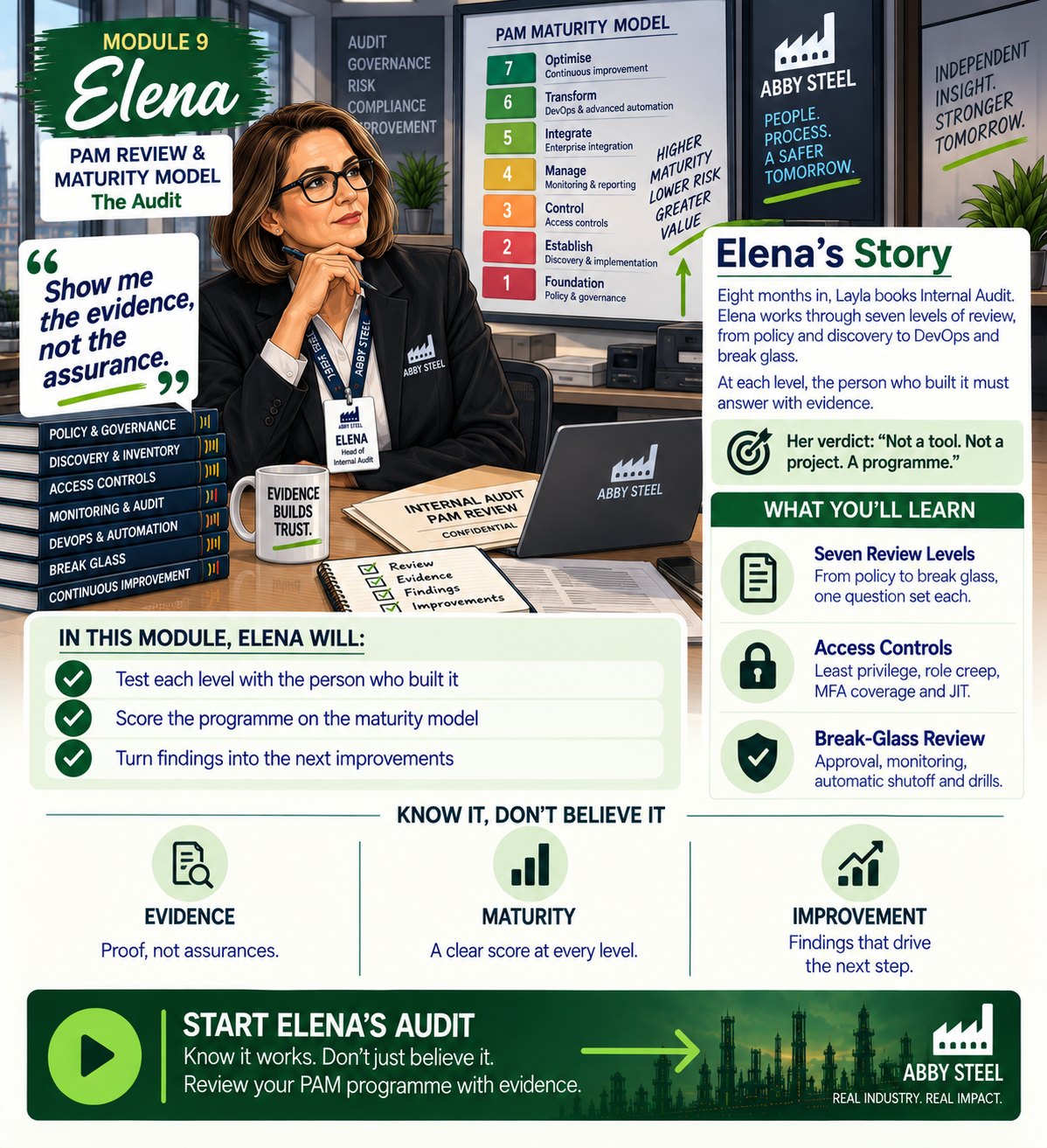
Module 9: Elena, Head of Internal Audit
Conducting a PAM Review and the PAM Maturity Model · “The Audit”. Elena audits Abby Steel across seven review levels, and each team member proves with evidence that the level they built truly works. Part of the PAM Academy, where every module follows one person through a real privileged access problem. Open Module 9 in the PAM Academy →
Who this module is for
PAM Programme Manager
A running improvement cycle with a review cadence, a findings register and a roadmap you can defend in a steering group without waiting for an audit to set the agenda.
CISO or Security Leader
Long-term measures that show maturity movement and reduced exposure over years, not activity counts, so PAM keeps its funding between incidents.
IAM Engineer or Security Architect
A practical view of where privileged access is heading, including zero trust alignment, machine identities and agentic AI, and how to prepare for it in the current architecture.
GRC and Compliance Manager
A findings lifecycle that turns audit observations into owned, dated remediation with evidence, and repeat findings that stop repeating.
Internal Auditor or Assurance Lead
A question-led review method across the maturity levels, and a clear sense of what good looks like when a programme answers with evidence rather than intent.
The problems this module solves
The programme ends when the project ends
Funding, governance and named ownership are all attached to a delivery project, so they all stop on the same day. Business as usual inherits a platform but not a mandate, and improvement work competes with incident queues it will always lose to. Within a year the programme is running on whatever attention individuals can spare.
Policy drifts away from practice
Documents are written once and reviewed on a calendar that nobody honours. A reorganisation, a new operating model or a divested business unit leaves the written control describing something that no longer happens. The drift is invisible until an auditor compares the two, and then it is a finding rather than an improvement.
Findings are logged but never closed
Audit and assessment produce a list, the list goes into a spreadsheet, and the items with no clear owner survive until the next review, where they are raised again. Repeat findings damage credibility with regulators and the board far more than the original issue did, because they show the organisation is not able to correct itself.
The estate changes faster than the controls
Cloud services, CI/CD pipelines, robotic process automation and now AI agents create privileged identities at machine speed, while onboarding runs at human speed. The gap between what exists and what is governed grows quietly, and the accounts outside the process are precisely the ones nobody is watching.
What you will learn
- Why reviewExplain the five benefits of a PAM review and maturity model: enhanced security, regulatory compliance, operational efficiency, proactive risk management, and accountability and transparency.
- Seven review levelsApply the question sets for the seven review levels: Policy & Process, Asset & Account Discovery, Access Controls, Monitoring & Auditing, Technology Integration, DevOps and Break Glass.
- Access controlsEvaluate access controls for least privilege, role creep, MFA coverage, time-bound and just-in-time access, and session management.
- Monitoring and integrationAssess whether monitoring, training and technology integration give real, evidenced visibility of privileged activity.
- Break-glass accessReview emergency (break-glass) access for approval, least privilege, monitoring, automatic termination, drills and post-incident review.
Why do PAM programmes lose momentum after go-live?
Most privileged access management programmes are funded as projects. Projects have an end date, and on that date the steering group dissolves, the delivery manager moves on and the budget line closes. What remains is a platform in business as usual, owned by a team whose day is already full. The controls still work, so the loss of momentum is not visible for months.
Decay then arrives from three directions at once. The estate changes: new systems, new suppliers, acquisitions, cloud migrations and pipelines all create privileged access that was never in the original scope. The organisation changes: a reorganisation moves accountability, and the approval workflow now names a team that no longer exists. The threat and regulatory picture changes: what counted as adequate protection two years ago is now the baseline expectation of an assessor.
The practical fix is to give the operational programme the things the project had. That means a named owner with executive sponsorship, a standing forum that meets on a fixed cadence, a budget line for improvement rather than only for licences and support, and a small set of measures reported whether or not anything went wrong. It also means treating exceptions as temporary by design. Every exception should carry an owner, a compensating control and an expiry date, because an exception with no expiry is simply an undocumented policy change.
One useful test: if your organisation were asked today how many privileged accounts it has, how many are unmanaged, and when the policy was last checked against how the business actually works, could the answer be produced in minutes with evidence? If it needs a project to answer, the programme has already drifted.
How do you build a continuous improvement cycle for PAM?
Continuous improvement works when it is a scheduled loop with named inputs and outputs rather than an intention. A workable cycle has five stages: review, innovate, improve, adapt, grow.
- Review. Assess the programme against a structured model on a fixed cadence. A useful structure covers policy and process, asset and account discovery, access controls, monitoring and auditing, technology integration, DevOps, and break glass. Ask questions at each level and accept only evidence or an honest statement that the evidence does not exist.
- Innovate. Take a deliberate look outward each cycle. What has changed in the platform, in the threat landscape, in regulation, and in how your own engineers work? Capture candidate improvements without committing to them yet.
- Improve. Convert findings and candidates into a prioritised backlog. Score by risk reduction, effort and dependency, and be willing to reject items that do not earn their place.
- Adapt. Change the controls to match how work actually happens. If a control is routinely bypassed, the control is wrong, not the people. Delivery will route around security that slows it down, so make the compliant path the fast path.
- Grow. Extend coverage into the estates left out of the first phase: legacy platforms, operational technology, third parties, subsidiaries and the newest cloud workloads.
Set the cadence explicitly. A light internal check each quarter, a full structured review annually, and a policy review triggered by any material business change is a defensible pattern for most organisations. Between cycles, run drills. Break-glass tests, incident-response rehearsals and vault failover exercises all produce findings that no document review will surface, and finding a gap in a drill is far cheaper than finding it in an emergency.
How do you turn PAM audit findings into remediation that sticks?
Every review produces findings. A review that produces none has either been gamed or scoped too narrowly to be useful. The score matters less than the gap list, because the gap list is the only part that changes anything. Mature organisations treat findings as the product of the review rather than an embarrassment to be negotiated down.
Give every finding the same three attributes: logged, owned and dated. Logged means it exists in one register, not in an email thread. Owned means a named individual, not a team name and not the PAM platform owner by default. Dated means a target remediation date agreed with that owner and visible to the sponsor.
- Classify by risk, not by ease. A pipeline token that never expires and a stale policy document are not the same finding, even though both are one line on a list.
- Find the cause, not just the instance. If two legacy integrations run on long-lived credentials, the fix is a rotation and ownership standard for integrations, not two credential changes.
- Verify with evidence. Closure means a query, a report or a screenshot of the corrected state, retained for the next review.
- Track repeats separately. A finding raised twice is a governance failure and should be escalated to the sponsor rather than reset with a new date.
Typical findings in an otherwise strong programme are mundane and worth knowing in advance: policies that drifted from practice after a reorganisation, legacy integrations still authenticating with long-lived credentials, a CI/CD token with no expiry, standing privilege that survived with no recorded justification, and break-glass accounts that have never been tested. None of these indicate a failed programme. Failing to close them does.
What does innovation in PAM look like: zero trust, machine identities and AI agents?
Innovation in privileged access is not a matter of buying new products. It is a shift in where the control sits, from protecting a shared credential to authorising a specific action, for a specific identity, at a specific moment.
Zero trust alignment. Zero trust assumes no implicit trust from network position or prior authentication. In PAM terms that means eliminating standing privilege, elevating just in time, re-verifying identity at the point of elevation, and making every privileged session attributable to a person or a system. Session brokering, strong device and identity signals and continuous verification during long sessions are the practical implementations.
Secretless and short-lived credentials. The strongest control over a secret is not to have one. Ephemeral credentials issued at the point of use, certificate-based authentication and workload identity federation remove the rotation problem instead of managing it. Where secrets remain, they should be vaulted, rotated on a known schedule and never present in code or configuration.
Machine identities. Non-human identities now outnumber human ones in most estates: service accounts, application identities, pipeline identities, robotic process automation and integration accounts. Each needs the same three things a human account needs, which are a named owner, a defined entitlement and a rotation and review cycle. Ownership is usually the missing one.
AI agents. Agentic tooling introduces identities that act autonomously, at speed, across systems, often using credentials granted for convenience. Treat an agent as a privileged non-human identity: give it its own identity rather than a borrowed one, scope its entitlements narrowly, issue short-lived credentials, record what it does, and define who is accountable for its actions.
Analytics and automation. Behavioural baselines, anomaly detection and automated onboarding, discovery and revocation reduce the manual work that makes programmes decay. Automate the repeatable parts first, because they are where drift begins.
How do you build a PAM roadmap that stays aligned to the business?
A PAM roadmap fails when it is a product plan. Vendor release notes are an input, not a strategy. A roadmap that survives contact with a steering group is organised around drivers the business already recognises.
Build it on four inputs. Business change: acquisitions, divestments, cloud migration programmes, new plants or sites, outsourcing arrangements and major application replacements all change the privileged access footprint. Risk trends: your own incident and near-miss history, sector threat intelligence and the attack patterns that actually target privileged access. Assessment findings: the gap list from the last review, weighted by risk. Regulatory and contractual deadlines: audit cycles, certification renewals and customer security requirements with dates attached.
Structure it in three horizons rather than as a single long list. The near horizon, roughly zero to six months, holds committed work with owners and dates. The middle horizon, six to eighteen months, holds planned work with scope agreed but detail still open. The far horizon, eighteen months and beyond, holds direction of travel such as secretless authentication, machine identity governance or extending coverage to operational technology.
- Trace every item to a driver. If an item cannot be traced, it does not belong on the roadmap.
- Sequence by dependency. Discovery and ownership come before automation, because automating an inaccurate inventory scales the inaccuracy.
- Leave capacity unallocated. Reserve a share of each period for findings and unplanned business change, or the first surprise will destroy the plan.
- Re-baseline on a schedule, typically twice a year, and record what changed and why.
Publish it. A roadmap that only the PAM team can see cannot align anyone, and alignment is the point.
How do you keep stakeholders engaged and measure long-term success?
Programmes lose support quietly. Nobody withdraws from PAM; attendance simply falls, then the forum lapses, then the improvement backlog stops moving. Engagement has to be designed with the same care as the controls.
Segment the audience and give each group something they actually need. Executives and the board need exposure, trend and residual risk in three or four measures, with the findings position and what it would cost to close it. Asset and system owners need to see their own estate: which of their accounts are managed, which are not, and what is expected of them next. Engineers and administrators need friction removed and a route to say what is not working, because they are the early warning system for controls that are being bypassed. Auditors and regulators need evidence produced on request rather than assembled on demand. Make feedback consequential by showing, each cycle, which changes came from it.
For long-term measurement, separate the two questions the organisation is really asking. Are we more mature? is answered by movement across the review levels between assessments, and by the shape of the findings list, whether items are closing faster and whether repeats are falling. Are we less exposed? is answered by trend lines: standing privilege remaining against baseline, coverage of discovered privileged accounts weighted by asset criticality, time from leaver to access revocation measured rather than asserted, and detection and containment times against your own targets.
Hold the baselines. Long-term measures are only meaningful across years, so keep the definitions stable and record when they change. The strongest evidence a programme can offer is that a question that once required a project can now be answered in minutes, with evidence, by whoever is asked.
Elena’s story
Two years after a forgotten service account brought Abby Steel to a halt, an independent auditor reviewed the programme across seven levels: policy and process, discovery, access controls, monitoring and auditing, integration, DevOps, and break glass. Her method was questions, answered with evidence or with an honest admission that the evidence did not exist. Discovery held up under the three questions that usually stall organisations: the joiners, movers and leavers status of every account owner, typical access patterns per account, and real password ages and rotation history rather than the policy. All three were answered from one system without leaving the room. Access controls showed standing privilege down ninety per cent from baseline, with a named justification for every survivor, and leaver access revoked same-day at an average of four hours. Monitoring showed detection in minutes and alert volumes tuned down forty per cent while catch rates rose. There were findings: two policies that had drifted after a reorganisation, two legacy integrations on long-lived credentials, one pipeline token with no expiry. Each was logged, owned and dated.
Common mistakes to avoid
Treating the go-live as the finish line
Governance, funding and ownership all end with the project, leaving a platform with no mandate to improve. Stand up an operational forum, a named owner and an improvement budget before the delivery project closes.
Gaming the assessment
Scoping a review to avoid uncomfortable areas produces a flattering score and no useful information. A maturity review is a mirror rather than a trial, so the value is in the gaps found, not the number reported.
Letting findings age without owners
Items assigned to a team rather than a person drift until they are raised again at the next review, and repeat findings damage credibility more than the original issue. Every finding needs a named owner, a target date and evidence-based closure.
Building the roadmap from the product backlog
A plan driven by vendor releases cannot be defended to a steering group because nothing on it maps to a business driver. Build from business change, risk trends, findings and regulatory dates instead.
Ignoring machine and agent identities until they cause an incident
Pipelines, integrations and AI agents create privileged access faster than manual onboarding can absorb it, and unowned non-human identities are the ones nobody notices. Bring them into discovery, ownership and rotation on the same terms as human accounts.
Key takeaways
- PAM is an operating discipline, not a project, so give it a cadence, an owner and a budget after go-live.
- Run the loop deliberately: review, innovate, improve, adapt, grow, with a fixed review schedule and regular drills.
- Findings are the product of a review, and every one should be logged, owned, dated and closed with evidence.
- Build the roadmap from business change, risk trends, findings and regulatory dates, and leave capacity for surprises.
- The direction of travel is less standing privilege, shorter-lived credentials and governed machine and agent identities.
Frequently asked questions
What is continuous improvement in privileged access management?
It is a scheduled cycle rather than an attitude. The programme reviews itself against a structured model on a fixed cadence, looks outward for new approaches and threats, converts findings into a prioritised backlog, adapts controls to how work actually happens, and extends coverage into estates that were out of scope earlier. Each stage has named owners and outputs. The point is that improvement work is planned and funded in advance, so the agenda is set by the organisation rather than by whatever the last audit or incident happened to expose.
How often should you review a PAM programme?
A common and defensible pattern is a full structured review annually, a lighter internal check each quarter, and an out-of-cycle policy review triggered by any material business change such as a reorganisation, an acquisition, a cloud migration or a new regulatory obligation. Break-glass tests and incident-response drills should run at least quarterly, because they surface gaps that document reviews never will. If your last review is more than twelve months old, assume drift has occurred and plan for findings rather than hoping for none.
What is the future of privileged access management?
The direction is away from managing shared secrets and towards authorising specific actions. Expect continued movement to just-in-time elevation with no standing privilege, short-lived and certificate-based credentials that remove the rotation problem, and workload identity federation in cloud estates. The larger shift is in scale: non-human identities, including service accounts, pipeline identities and AI agents, already outnumber human ones in most organisations, so ownership, entitlement scoping and lifecycle control for machine identities become the main workload. Analytics and automation take over the repeatable tasks where drift usually starts.
How does PAM support a zero trust strategy?
Zero trust removes implicit trust based on network position or an earlier login, and privileged access is where that principle bites hardest. In practice PAM delivers it by removing standing administrative rights, elevating just in time for a defined task and duration, re-verifying identity and device at the point of elevation, brokering sessions so credentials are never handled directly, and recording every privileged session so activity is attributable. Continuous verification during long-lived sessions and behavioural baselining complete the picture, since a single check at the start of a session is not continuous verification.
How do you secure machine identities and AI agents?
Treat them as privileged non-human identities with the same lifecycle expectations as people. Discover them first, because most organisations underestimate how many exist. Give each one a named human owner, an explicit entitlement scope and a rotation or expiry schedule, and never let an agent or pipeline borrow a human credential. Prefer short-lived or federated credentials over static secrets, vault anything that must persist, and record what the identity does so its activity can be reviewed. For AI agents, define in advance who is accountable for actions taken on the agent’s behalf.
Start Module 9 in the PAM Portal
Work through Elena’s module in full, with the walkthroughs, templates and assessment that turn this into something you can apply on Monday morning.
Open Module 9 in the PAM Portal
Vendor-neutral. Built by practitioners. Designed around the roles that do the work.