
The PAM Academy · Module 4
Most organisations do not fail at privileged access management because they lack a policy. They fail because the controls behind the policy are thin, inconsistent, or applied identically to systems that carry wildly different risk. A domain controller, a database of customer records, a furnace controller and an edge switch all end up with the same tired mix of a shared password and a promise that only the right people know it.
The result is predictable. Standing privilege accumulates, vendor accounts outlive the contracts that justified them, sessions go unrecorded, and the first person to notice a breach is somebody outside the organisation. Nearly every well-known privileged access incident of the last fifteen years traces back to a control that was missing, misapplied, or never tested.
This module is about closing that gap. It covers how to select controls that match your risk, how to implement least privilege and access governance without stalling the business, how to secure admin and service accounts, how to monitor and audit privileged activity so detection actually happens, and how to test controls and improve them over time.
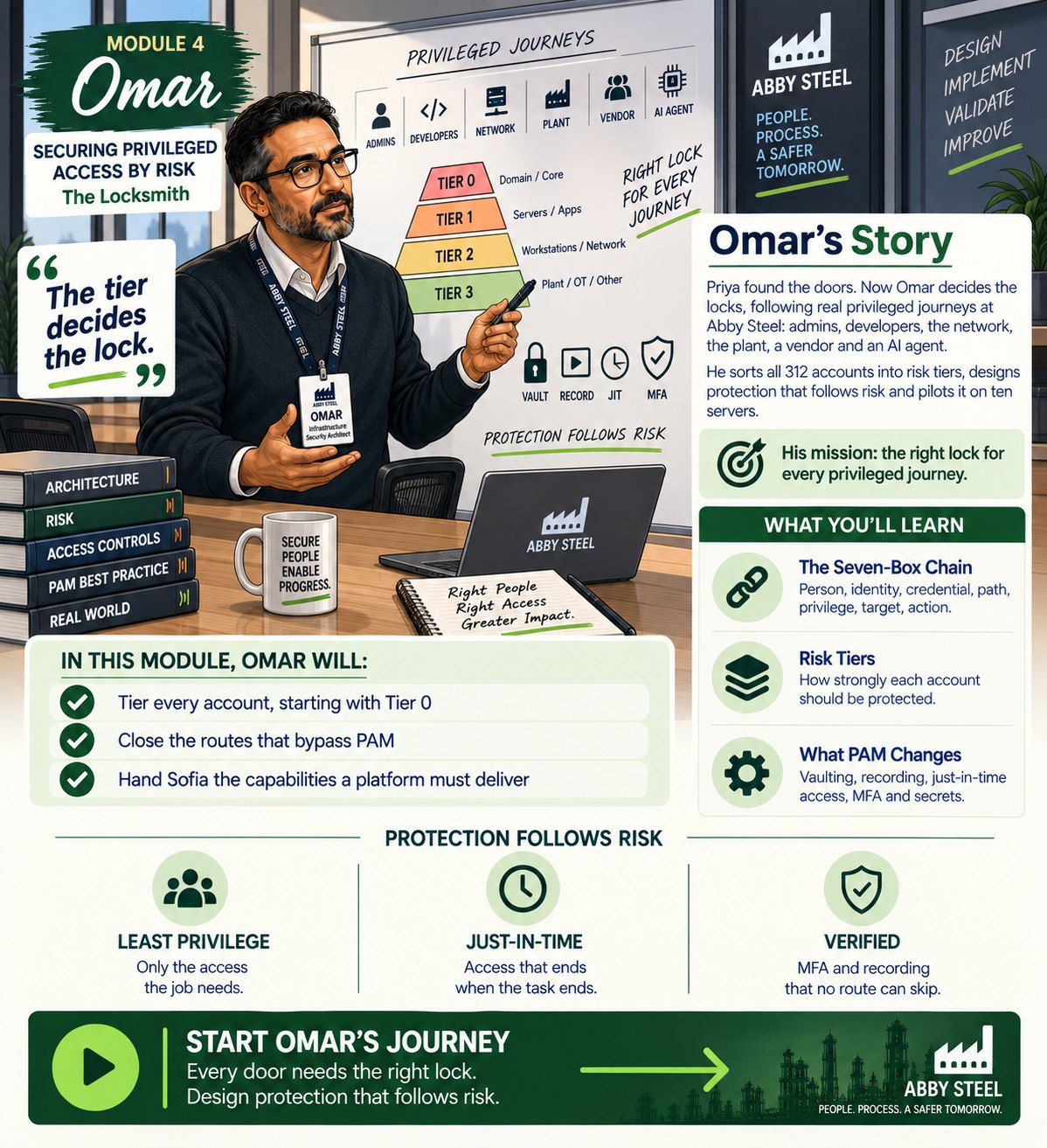
Module 4: Omar, Infrastructure Security Architect
Securing Privileged Access by Risk · “The Locksmith”. Omar turns Priya’s list of 312 privileged accounts into a risk-tiered design, deciding the right lock for every privileged journey. Part of the PAM Academy, where every module follows one person through a real privileged access problem. Open Module 4 in the PAM Academy →
Who this module is for
IAM Engineer
A concrete implementation order for least privilege, role design, just-in-time access and credential vaulting, including how to handle the exceptions that always appear.
Security Architect
A control framework that maps protection to risk across servers, operational technology, databases and network devices instead of applying one template everywhere.
CISO or Head of Security
The business case for privileged access controls, the metrics that show whether they work, and the failure patterns to raise with the board before an auditor does.
GRC and Compliance Manager
How access reviews, segregation of duties, session evidence and audit logging translate into defensible proof for regulators and auditors.
IT Operations and OT Engineering Leads
Practical ways to apply privileged access controls in legacy and uptime-critical environments where standard agents and patch windows are not available.
The problems this module solves
Every system protected the same way, so nothing is protected properly
When controls are applied uniformly, the highest-risk systems get the same treatment as a print server and the budget is spread too thin to secure any of them well. Risk-matched control design is the difference between a policy that looks complete and an estate that actually resists attack.
Standing privilege that nobody can justify
Permissions accumulate through role changes, projects and favours, and they are almost never handed back. Every dormant privileged account is a permanent, unmonitored entry point, and attackers look for exactly these before they look for a vulnerability.
Third parties and service accounts with far more access than the job requires
Vendor and machine identities are usually granted broadly at onboarding and then forgotten. In the Target breach of 2013, intruders entered using the credentials of a heating and air-conditioning subcontractor whose access rights far surpassed their work requirements, then moved through a flat network to payment systems.
Logging that produces evidence but never produces detection
Many organisations record privileged activity and never look at it, so alerts do not fire and reviews do not happen. Capital One’s 2019 breach, affecting over one hundred million customers in the United States and approximately six million in Canada, was eventually discovered through a tip from an external researcher rather than by internal monitoring.
What you will learn
- The seven-box chainTrace any privileged journey through the seven-box chain: person, identity, credential, path, privilege, target and action.
- Risk tiersUse risk tiers to decide how strongly each account should be protected.
- What PAM changesExplain what core PAM capabilities change in a journey, from vaulting and credential injection to session recording, just-in-time access, MFA and secrets management.
- The complicationsSpot the complications: service account dependencies, bypass routes, OT constraints, the help desk reset path, exceptions and break-glass.
- Capabilities, not productsName the capabilities a use case needs without choosing a product.
What are PAM controls, and how do you choose the right ones?
PAM controls are the specific, testable measures that determine who may hold privilege, under what conditions it can be used, what is captured while it is used, and how misuse would be detected. A policy states intent; a control enforces it and can be evidenced.
Run control work through five stages rather than treating it as a shopping list:
- Identify: know the privileged accounts, systems, dependencies and data they touch, because you cannot control what has never been inventoried.
- Protect: apply preventive controls such as least privilege, role-based access, multi-factor authentication, credential vaulting and secure remote access.
- Detect: apply detective controls such as session recording, activity monitoring, alerting and behavioural analytics.
- Respond: define what happens when a control fires, from revocation and credential rotation to isolation and incident response.
- Improve: test, measure and refine so the control set tracks the estate as it changes.
The principle underneath all of it is that protection follows risk. Everything equally protected means nothing properly protected. Group the estate and set a control baseline for each group:
- Privileged servers, the workhorses that run the business services.
- Industrial control systems, where a compromised account moves physical machinery rather than data.
- Database systems, where the most valuable data actually lives.
- Network devices, the roads between everything, where owning the path makes every destination reachable.
Within each group, select from three control types: preventive controls stop the action, detective controls reveal it, and corrective controls recover from it. Where a system cannot take a standard control, for example a legacy controller that predates modern authentication, document a compensating control such as a bastion host, segmentation and recorded sessions rather than leaving the gap unnamed. One constraint applies everywhere: controls must align with the organisation’s security strategy, risk tolerance and regulatory obligations while remaining usable. Controls that disrupt workflows get worked around, and a worked-around control protects nothing.
How do you implement least privilege without breaking the business?
Least privilege means users, systems and applications hold only the minimum access their tasks require, and no more. The purpose is to reduce both unauthorised actions and unintended ones, because well-meaning people cause outages too.
Four benefits make the case internally. Risk is minimised, because an account that only needs to read a database cannot alter it even when compromised. Audits are simplified, because there are fewer permissions to sift through. Troubleshooting is easier, because fewer permissions mean fewer places to look. And accidental changes fall, because someone who cannot change a thing cannot break it by mistake.
Implement in sequence rather than a single sweep:
- Baseline actual usage. Use activity data to see which privileges are genuinely exercised; entitlement counts alone mislead.
- Separate duties from identities. Administrators should hold a distinct privileged account, never elevated rights on the account they use for email and browsing.
- Tier the environment. Define which credentials may be used on which tier so that a workstation compromise cannot yield domain-level control.
- Remove standing privilege in waves. Start with dormant and orphaned accounts, then vendor and contractor access, then long-standing local administrator rights.
- Replace it with just-in-time and just-enough access. Grant privilege only for the period needed, only for the systems required, and revoke it automatically when the task completes.
- Handle exceptions formally. Every retained standing privilege should have a named owner, a justification and an expiry date.
The counter-example is instructive. In the Target breach, the critical oversight was least privilege neglected for a vendor account: a company that only needed access for heating systems could reach the payment network. Excessive privilege multiplied by flat networks is what turns an incident into a landmark breach, which is why segmentation and least privilege are implemented together.
Access governance: RBAC, ABAC, segregation of duties and joiner-mover-leaver
Least privilege is the goal. Access governance is the machinery that keeps it true as people join, move and leave.
Joiner-mover-leaver. The mover event causes most privilege creep, because new access is granted and old access is rarely removed. Build the leaver and mover paths first, trigger them from the HR system rather than a ticket, and treat contractors as first-class identities whose contract end dates automatically expire access.
RBAC. Role-based access control regulates access by the user’s role in the organisation rather than by history or favours. It is predictable, easy to audit and easy to explain to an auditor. Its weakness is role explosion: roles built around individuals rather than job functions multiply until nobody can say what a role grants. Derive roles from job functions, keep the count small enough to review, and give every role a named owner who recertifies it.
ABAC. Attribute-based access control evaluates attributes at the moment of the request, such as device posture, location, time of day, data classification or ticket state. It handles context-heavy scenarios that RBAC cannot express without inventing dozens of roles, at the cost of policies that are harder to test and explain.
Most mature privileged designs are hybrid. RBAC establishes the coarse grant, deciding who is eligible for a privileged role. ABAC conditions the activation, deciding whether this request, from this device, at this time, with this approval, is allowed. Just-in-time access is the natural product of that pairing.
Segregation of duties. No single person should control a sensitive process end to end. In IT that means the person who requests access does not approve it, the person who writes code does not approve its release to production, the person who administers a system does not own its audit logs, and the person who creates a supplier record does not release payment to it. Where headcount makes true separation impossible, apply compensating detective controls: dual approval, out-of-band notification and mandatory review of the actions taken.
How do you secure admin, service and shared privileged accounts?
Admin accounts are the objective of most intrusions, so the controls around them should be deliberate rather than inherited.
- Multi-factor authentication on every privileged login. Combine factors from independent categories: something you know, something you have, something you are. A phished password on an ordinary account is a problem; on a domain administrator it is a catastrophe unless a second factor stands behind it.
- Vault the credentials. Shared and administrative passwords belong in an encrypted vault with checkout, automatic rotation and full attribution, not a spreadsheet.
- Unique credentials per device. No shared administrator password reused across the estate, particularly on network devices where one credential opens hundreds of them.
- Proxy-based access. Users connect to the PAM platform, which connects to the target, so nobody touches critical systems directly. This cuts the path for malware and makes recording straightforward.
- Bastion or jump hosts. Fortified, closely monitored machines serving as the only entry point into a sensitive network, with every other internal system unexposed behind them.
- Time-bound access. Grant for a duration or within a defined window, so the opportunity for misuse shrinks even if credentials leak.
- Break-glass accounts. Keep few, seal them, alarm every use and rotate immediately afterwards.
- Endpoint security for admin workstations. A hardened database reached from a compromised laptop is not hardened. Apply application allow-listing, current anti-malware and regular patching.
Service accounts need their own treatment because they cannot use interactive multi-factor authentication. Give each a named owner, a documented purpose and dependency list, a scope limited to the exact function, and deny interactive logon. Move to managed or ephemeral credentials where the platform supports it, and rotate the rest on a schedule tested against the applications that depend on them.
Adapt the baseline by estate. Databases add read-only application accounts, activity monitoring, database firewalls and encryption at rest and in transit. Network devices add isolated management networks, configuration backups, change control, firmware patching and logs shipped off-device so an intruder cannot erase their footprints. Operational technology adds segmentation from the business network behind stringent firewall rules, because an office email compromise must never be able to reach a furnace.
What does effective privileged session monitoring and auditing look like?
Monitoring is the control that tells you whether the others are holding. Done properly it delivers three things at once: an audit trail that identifies inappropriate behaviour, evidence that satisfies compliance obligations, and material for forensic investigation. Start with what to capture:
- Session recording with command or keystroke logging where the protocol allows, so the record shows what was done rather than only that a connection occurred.
- Credential events: checkout, checkin, rotation failures and vault administration activity.
- Entitlement changes: privileged group membership, role assignment, policy edits and new local administrator accounts.
- Database activity: query volume, schema changes and bulk exports.
- Device and platform events: configuration changes, firmware updates and authentication failures, shipped to a central store off the device.
Then decide what should wake someone up. Useful alert cases include a privileged account exporting a million rows at midnight, a credential checked out with no matching change ticket, privileged logon from an unusual location or hour, a new member in a network administrator group, session recording failing on a critical target, and any use of a break-glass account.
Behavioural analytics improve this further by building patterns of normal privileged behaviour and flagging anomalies, but they depend on the inventory and baseline work done beforehand. Analytics applied to an unmapped estate produce noise, not detection.
Two failure modes are worth naming. The first is recording without review, where sessions accumulate and nobody watches one. Sample them on a defined cadence, and always review sessions attached to an alert or emergency change. The second is alerting without triage, where volume is so high that genuine signals are dismissed. Tune aggressively, route alerts to a team with authority to revoke access, and measure how long triage takes. In the 2018 SingHealth breach, around one and a half million patients had personal data accessed after attackers used privileged credentials to reach the database from a compromised front-end workstation, without real-time detection ever firing.
How do you test PAM controls and prove they are working?
An untested control is an assumption. Testing turns the control set from a design document into something you can defend in a board paper or an audit. Test the control, not the policy:
- Attack simulation. Attempt the paths you have designed against: credential reuse across tiers, privilege escalation from a standard workstation, direct connection to a target that should only be reachable through the proxy, and lateral movement between segments.
- Access review sampling. Rather than accepting a completed recertification, sample it and verify access matches the current role, and that revocations were executed rather than merely approved.
- Leaver and vendor expiry tests. Pick recent leavers and expired contracts and check whether every account, key and device credential is genuinely gone.
- Break-glass and recovery drills. Use an emergency account under observation, confirm the alarm fires and the credential rotates, and rehearse restoring from backup rather than assuming it will work.
- Configuration drift checks. Compare live policy, firewall rules and device configurations against the approved baseline on a schedule.
Measure a small set of metrics that reflect effectiveness rather than activity: coverage of privileged accounts under vault management, the number of accounts holding standing privilege and its trend, multi-factor authentication coverage on privileged logins, session recording coverage on critical targets, mean time to revoke access after a leaver event, the proportion of access granted just-in-time, alert triage time, and review completion with exceptions closed.
Then close the loop. Every incident, near miss, failed test and audit finding should produce a control change, an owner and a date. Retire controls that cost more than they evidence, and strengthen those that consistently catch real issues. The estate keeps changing, so a control set that is never revisited is quietly becoming inaccurate.
Omar’s story
Omar inherits a map rather than a clean sheet. The discovery work at Abby Steel has surfaced three hundred and twelve unknown privileged accounts spread across servers, databases, network devices and the industrial control systems that keep the furnaces at sixteen hundred degrees. His view is that protection has to follow risk, because everything equally protected means nothing properly protected.
So he works estate by estate. Servers get multi-factor authentication, vaulted credentials, role-based access, just-in-time provisioning, recorded sessions and controlled remote paths. The control network gets bastion hosts as the only entry point, segmentation behind strict firewall rules, and controls chosen to respect legacy equipment that cannot simply be rebooted for a patch. Databases get read-only application accounts, activity monitoring, encryption and time-bound access. Network devices get unique credentials, an isolated management network and logs shipped off-device.
Six months later the estate is risk-matched, and Omar tells the programme sponsor the honest part: the controls are right, but they are being run with spreadsheets, scripts and willpower. The machinery to sustain them does not exist yet.
Common mistakes to avoid
Applying one control template to every system
Uniform controls spread effort thinly and leave the highest-risk systems underprotected while low-risk ones absorb budget. Set a baseline per risk group and add controls where consequence is highest.
Building roles around people instead of job functions
Roles copied from an individual’s current access encode existing privilege creep and multiply until nobody can review them. Derive roles from job functions, keep the number reviewable, and give each an owner who recertifies it.
Granting vendors and service accounts broad access at onboarding
Access granted for convenience on day one is almost never trimmed back, and non-human identities rarely appear in reviews. Scope them to the exact function, attach an owner and an expiry, and include them in every recertification.
Recording sessions and logging activity that nobody ever reviews
Evidence without review is not detection, and it will not stop an incident in progress. Define alert cases, route them to a team with authority to revoke access, and sample recorded sessions on a fixed cadence.
Treating password protection as a substitute for encryption
In the 2017 Horizon Blue Cross Blue Shield case, two stolen laptops exposed files on nearly eight hundred and forty thousand individuals because the devices were unencrypted. Encrypt sensitive data everywhere it lives, in transit and at rest, and manage the keys as the master credentials they are.
Key takeaways
- Protection follows risk: set a control baseline per risk group rather than one template for the whole estate.
- Least privilege is implemented in waves, starting with dormant and vendor access, and finished by replacing standing privilege with just-in-time grants.
- RBAC decides who is eligible for privilege; attribute-based conditions decide whether this specific request should be activated now.
- Admin, shared and service accounts need vaulting, rotation, multi-factor authentication and proxy-based access, with named owners for every non-human identity.
- A control you have not tested is an assumption, so measure standing privilege, revocation time, coverage and triage time, then feed the results back into the design.
Frequently asked questions
What are PAM controls?
PAM controls are the specific measures that govern privileged access: who may hold it, under what conditions it may be used, what is captured while it is used, and how misuse is detected. They fall into preventive controls such as least privilege, role-based access, multi-factor authentication and credential vaulting; detective controls such as session recording, activity monitoring and alerting; and corrective controls such as automatic revocation, credential rotation and recovery. A policy states intent, while a control enforces that intent and produces evidence that it was enforced.
What is the difference between RBAC and ABAC for privileged access?
Role-based access control grants permissions according to a person’s role in the organisation, which makes it predictable and straightforward to audit, but it struggles with conditional scenarios and can lead to role explosion. Attribute-based access control evaluates attributes at request time, such as device posture, location, time, data classification or approval status, which handles context well but is harder to test and explain. Most mature privileged access designs use both: role-based rules determine who is eligible for a privileged role, and attribute-based conditions determine whether a given activation request is allowed right now.
How do I implement least privilege without breaking things?
Work from evidence and move in stages. Baseline which privileges are actually exercised rather than which are assigned, separate administrative accounts from everyday accounts, and tier the environment so workstation credentials cannot reach domain-level systems. Then remove standing privilege in waves, beginning with dormant, orphaned and expired vendor access, and replace it with just-in-time, just-enough grants that expire automatically. Keep a formal exception route so that anything retained has an owner, a justification and an expiry date, and monitor for access denials so genuine business needs are resolved quickly rather than worked around.
What is segregation of duties in IT?
Segregation of duties means no single person controls a sensitive process from beginning to end. In practice, the person who requests access does not approve it, the person who develops code does not authorise its release to production, the person who administers a system does not own its audit logs, and the person who creates a supplier record does not release payments to it. It limits both fraud and undetected error. Where a team is too small for true separation, apply compensating detective controls such as dual approval, out-of-band notification of privileged changes, and mandatory review of actions taken.
Do I need to record privileged sessions, and what should I do with the recordings?
Session recording gives you an audit trail that identifies inappropriate behaviour, evidence for compliance obligations, and material for forensic investigation. Record privileged sessions on critical targets, and capture commands or keystrokes where the protocol allows, so the record shows what was done rather than only that a connection happened. Recordings are only useful if they are used: review every session attached to an alert, an emergency change or a break-glass event, sample the rest on a defined cadence, protect the recordings themselves with encryption and access control, and set retention to match your regulatory requirements.
Start Module 4 in the PAM Portal
Work through Omar’s module in full, with the walkthroughs, templates and assessment that turn this into something you can apply on Monday morning.
Open Module 4 in the PAM Portal
Vendor-neutral. Built by practitioners. Designed around the roles that do the work.