
The PAM Academy · Module 10
Privileged access management sits at or near the top of security priority lists year after year, and the money follows it. The market is heading towards thirty billion dollars by 2034. A credential breach costs an organisation an average of 4.88 million dollars and takes 292 days to detect. The case for doing something is not in doubt.
What is in doubt is whether the something gets finished. Industry surveys keep finding the same wreckage: deployments stuck at partial coverage years after purchase, vaults protecting a fraction of the accounts a proper discovery exercise would find, licences bought, shelved and quietly renewed. The industry calls that shelfware. Then there are the restarts, where project two inherits project one’s scars plus its scepticism. Only a small minority of organisations ever reach the governance stage of PAM maturity. The gap between how many start and how few arrive is the subject of this page.
PAM projects rarely fail for exotic reasons. They fail in a small number of repeatable ways, and each one has a discipline that prevents it. What follows is a post-mortem of the ten failure modes, written so you can recognise them in your own programme early enough to change course.
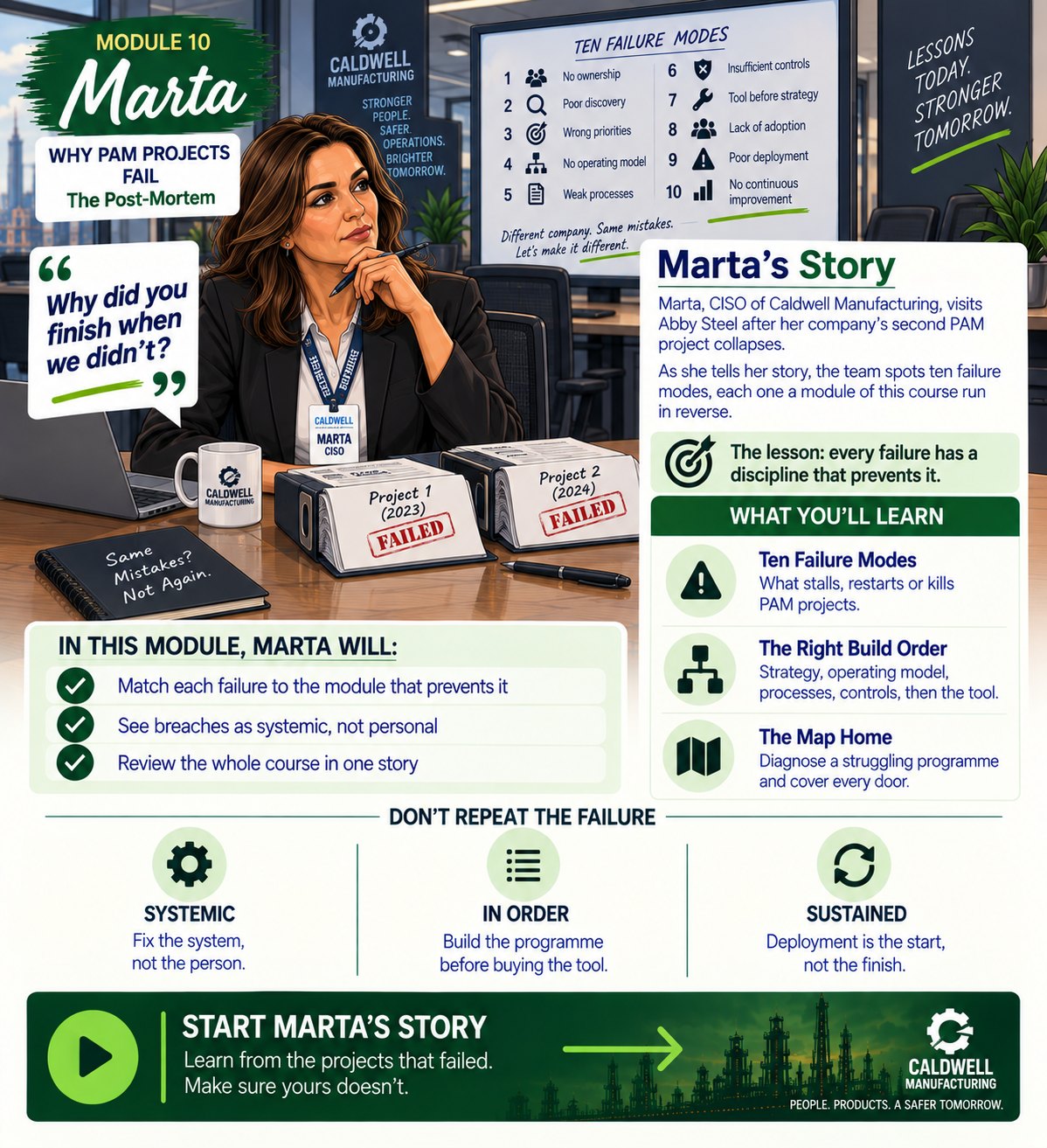
Module 10: Marta, Chief Information Security Officer, Caldwell Manufacturing
Why PAM Projects Fail · “The Post-Mortem”. Marta, CISO of Caldwell Manufacturing, learns why two PAM projects died: ten failure modes, each the dark mirror of a module. Part of the PAM Academy, where every module follows one person through a real privileged access problem. Open Module 10 in the PAM Academy →
Who this module is for
CISO or Security Director
A diagnostic checklist for judging whether a PAM programme is genuinely progressing or quietly becoming shelfware, and language to explain the difference to a board.
PAM Programme or Project Manager
The failure modes that kill delivery timelines, and the sequencing rule that keeps budget flowing quarter after quarter.
IAM Engineer or Security Architect
A view of how technically sound designs still fail on discovery gaps, integration cost and unmonitored controls, so you can design around those risks.
IT Operations and Service Desk Lead
Evidence of what a badly landed go-live does to operational teams, and the pilot, phasing and rollback practices that prevent blanket exemptions.
GRC, Audit and Compliance Manager
The signals that separate a programme with real assurance from one whose status reports stay green until everything turns red.
The problems this module solves
The tool is installed but nobody privileged uses it
A platform can be fully deployed and still protect almost nothing, because exemptions, workarounds and unonboarded accounts have hollowed it out. Renewal invoices keep arriving for a control that is not in the path of real privileged work, and the organisation carries the risk it believed it had removed.
Coverage stalls at a fraction of the estate
Scope was set from the accounts somebody already knew about rather than from discovery, so the vault protects a visible tenth while service accounts, local administrators and vendor logins stay in shadow. Every audit then becomes an archaeology exercise across the same systems.
The restart inherits the last project’s reputation
When a second attempt follows a failed first, the technical problem is the easy part. Operations teams remember the outage, finance remembers the write-off and the board remembers the promises, so the new programme has to earn credibility before it can earn budget.
Nobody can tell whether the programme is working
Without a maturity baseline, independent review or agreed measures, status reporting drifts towards optimism. The programme does not know it is failing, which is not the same as succeeding, and the gap only becomes visible when an incident or an auditor exposes it.
What you will learn
- Ten failure modesRecognise the ten failure modes that stall, restart or kill PAM projects.
- The module that prevents eachLink each failure mode to the module whose discipline prevents it.
- Systemic, not individualExplain why treating a breach as an individual failure rather than a systemic one guarantees it will happen again.
- The right build orderApply the correct order for building a programme: strategy, operating model, processes, controls, and only then the tool.
- The map homeUse Layla’s ‘map home’ to diagnose a struggling programme and cover every door: human, machine, outsider and emergency.
Why do PAM projects fail so often?
PAM failure is rarely a single dramatic event. It is usually a slow divergence between what an organisation bought and what it actually operates. The investment case is signed on real numbers, an average credential breach cost of 4.88 million dollars and 292 days to detect one, and then the programme is run as a procurement exercise rather than a change to how access works.
Three patterns account for most of the wreckage:
- Partial coverage that never closes. The platform is live, but the percentage of privileged accounts genuinely under management stops climbing. Years after purchase the estate is protected in patches.
- Shelfware. Licences are bought, the deployment stalls, and the renewal is approved each year because cancelling would require admitting the failure. The control exists on paper and in the budget, not in the path of privileged work.
- Restarts. The project is stopped and relaunched with new consultants, a new platform or a new sponsor. Project two carries project one’s scars, and the people it needs most have already decided how this ends.
The underlying cause is almost always the same: the organisation treated PAM as a purchase rather than a discipline. A tool dropped into an environment with no strategy, no operating model and no process does not fix chaos, it automates it. If access was granted by favour before the vault, it is granted by favour after the vault, through a nicer interface.
So the useful question is not whether your platform is good. It is whether you can name the owner of access decisions, the discovery you have done, the risk ranking you are working through, the measures you report and the people who are watching. If several answers are missing, the failure has already started.
The 10 reasons PAM projects fail, and the lesson that prevents each
Each failure below is the mirror image of a discipline taught elsewhere in this course. Read them as a diagnostic list.
1. Blame the person, keep the system
An incident is treated as an individual’s mistake. Someone is disciplined, a memo about personal accountability circulates, and the system that created the forgotten account, no ownership, no reviews, no lifecycle, keeps running untouched. Eighteen months later a different person’s account does the same thing. Module 1’s lesson prevents this: until you treat the breach as a process problem, you repeat it with better documented scapegoats.
2. A tool without a programme
The board demands action, so IT buys a vault. No strategy, no operating model, no named owner for access decisions, no success measure beyond deploying the tool and no executive sponsor. Module 2’s sequence is the fix: strategy, then operating model, then processes, then controls, and the tool fifth.
3. Securing only the accounts you already know about
Scope comes from a list somebody kept rather than from discovery across directories, IAM, logs, access control lists and interviews. One manufacturer scoped ninety privileged accounts; a comparable estate that ran full discovery found 312 accounts nobody had on any list, plus 47 orphaned and 89 over-privileged. Module 3’s rule: you cannot protect what you cannot see, so collect once and audit forever.
4. Boiling the ocean
Everything, everywhere, at once. No risk ranking and no sequence, so test lab servers are argued over with the same energy as payment systems. Twelve months in, everything is fifteen per cent protected, nothing is finished, and the board sees burn rate without wins and stops the money. Module 4’s rule is that protection follows risk, and visible quarterly wins are how a programme keeps earning its budget.
5. Buying the demo, not the fit
A strong demonstration, a discount expiring at quarter end, and a signature in the same month. No requirements written first, no proof of concept on your own systems, and no integration costing, which is where the largest hidden cost arrives. Every connector becomes a custom project and every upgrade breaks two of them. Module 5’s rule: requirements first, vendors second, and price every integration.
6. Deployment as an event, not a methodology
Big bang go-live across every site and user, announced by email days before. Supervisors locked out of production systems, a four hour help desk queue by nine in the morning, and by midweek blanket exemptions for whole departments. The tool stays installed and nobody privileged uses it. Module 6 prevents it: pilot, phase, communicate ahead of the change and rehearse the rollback.
7. Deploy and walk away
Sessions recorded to storage nobody opens, alerts firing into an unstaffed mailbox until a rule archives them, and an operational handover line that was never resourced. One organisation had an attacker inside for seven months with the evidence sitting in its own recordings. Module 7’s rule: collected is not monitored and monitored is not understood, so fund the watch.
8. A programme frozen in time
The design assumes the estate of five years ago while the business moves to multiple clouds, container pipelines, machine identities and AI agents with delegated access that nobody security reviewed. The fastest growing part of the identity estate becomes the least protected. Module 8’s habit is horizon scanning: principles hold, tempo changes.
9. Never measured, never mirrored
No maturity model, no independent review, no honest mirror. Status stays green until the day it is red, because nobody was ever asked a hard question with evidence required. Module 9 supplies the structured assessment that lets a programme catch itself before an attacker does.
10. The forgotten doors
Humans get vaulted while machines, outsiders and emergencies stay in shadow: a machine identity with a five year old password set by a developer who has left, a vendor login from a project that ended years ago, and self made break-glass credentials in a desk drawer. This failure draws on the whole series and is the theme of Module 10. A PAM programme covers humans, machines, outsiders and emergencies, or it is a partial map with an attacker standing in the blank space.
What is PAM shelfware, and how do you spot it early?
Shelfware is a licence that is paid for and renewed while the control it represents is not in the path of real privileged work. A slow deployment is still moving. Shelfware has stopped, and the organisation has stopped noticing.
The early signals are operational rather than financial:
- Coverage has flatlined. The percentage of discovered privileged accounts under management has not moved in two or three reporting cycles, and nobody is asking why.
- Exemptions outnumber onboardings. Departments hold blanket exclusions granted during a difficult go-live, and no one owns the plan to bring them back in.
- Alerts go to an unstaffed destination. Thousands of notifications a week, untuned, with a mailbox rule quietly filing them away. Session recordings accumulate and are never opened.
- Discovery has never been repeated. The account inventory is a point in time list, so new services, new clouds and new vendors never enter scope.
- Reporting describes activity, not outcomes. Slides count workshops held and accounts touched rather than risk reduced or standing privilege removed.
- Renewal is decided by finance, not by security. If the annual conversation is about cost rather than value delivered, nobody is defending the outcome.
The test that cuts through all of it is simple. Pick your three most critical systems and ask how an administrator obtained privileged access to each of them last week. If the honest answer involves a standing account, a shared password or a documented exception, the platform is not protecting those systems regardless of what the deployment dashboard says.
Shelfware is recoverable, but not by buying more licences. Re-run discovery, choose one high value estate, remove the exemptions there with the affected teams involved, and report the result. Coverage that moves on something that matters restores more credibility than a full re-plan.
How do you rescue a stalled or restarted PAM project?
A restart is harder than a first attempt, and the difficulty is not technical. Operations remembers the lockout, finance remembers the write off, and the teams whose cooperation you need have already formed a view. Scepticism is the inherited liability, and the recovery plan has to pay it down first.
A workable sequence for the first ninety days:
- Run the post-mortem honestly. Name which of the ten failure modes applied. Most stalled programmes carry three or four. Write them down and share them, because a recovery that pretends the first attempt was fine convinces nobody.
- Re-establish ownership. Confirm who owns access decisions, who owns the platform and who owns the operational watch. If those three answers are missing, fix them before touching scope.
- Re-run discovery properly. Treat the old inventory as a hypothesis. Discover across directories, IAM, logs, appliances, cloud platforms and interviews, capturing owner, lifecycle linkage, access patterns and credential reality in one pass.
- Rank by risk and pick one estate. Choose a crown jewel system where success is visible and the stakeholders are willing. Finish it completely rather than starting everywhere.
- Land it as a methodology. Pilot with a group that is friendly but not tame, phase the rollout, communicate ahead of every change and rehearse the rollback so the only available fallback is not abandoning the control.
- Fund the watch on day one. Name who reviews alerts and sessions, at what frequency, with what escalation. An unmonitored control is a future finding.
- Publish a baseline and report against it. A maturity assessment before you start gives you something to improve from and protects you from the green status trap.
Two rules hold the recovery together. Do not relaunch the scope that failed, because repetition confirms the sceptics. And deliver a completed, provable win inside two quarters, because credibility is rebuilt with evidence rather than plans.
How do you build a PAM programme that survives?
The organisations that finish do not have more budget or better luck than those that stall. They treat each step as a discipline instead of treating the whole thing as a purchase. A durable programme rests on a handful of ordering rules, applied consistently.
- Fix the blame culture first, or every other problem gets hidden from you. People who expect to be punished for reporting a gap will stop reporting gaps.
- Strategy before tooling. Know what you are trying to achieve, who owns access and how decisions get made before a platform enters the conversation.
- Discovery before protection, and collect once so you can audit forever.
- Risk before sequence. Everything equally protected means nothing properly protected.
- Requirements before vendors, with every integration priced against your own IAM, ticketing and operational technology estate.
- Landing before celebration. A control that operations cannot live with will be exempted, and exemptions rarely get reversed.
- Watching before trusting. The distance between a 292 day average detection time and anomaly detection in under an hour is not technology, it is whether somebody is actually watching.
- Horizon before comfort. Machine identities, cloud platforms and delegated AI access grow faster than the programme that ignores them.
- Measurement before confidence. An unmeasured programme does not know it is failing, which is not the same as succeeding.
Then there is coverage. A programme accounts for every door: human administrators, machine and service identities, vendor access, and emergency break-glass credentials that are designed and drilled rather than laminated and left in a drawer. Quarterly rehearsals, some unannounced, turn an assumption into a capability.
Finally, run it as a programme rather than a project. Projects have end dates and the estate does not. Keep discovery recurring, the risk ranking current, evidence in front of people with authority to act, and maturity reassessed on a schedule. Not a tool, not a project, a programme.
Marta’s story
Marta is CISO of Caldwell Manufacturing, a heavy industry business with global sites and decades of legacy systems. Caldwell has run two PAM projects. Both were funded, both were staffed, both are dead. The first followed a breach through an engineer’s forgotten service account: the company held a disciplinary review, issued a memo on individual accountability, bought a vault, and changed nothing about ownership, reviews or lifecycle. Its scope listed ninety privileged accounts, the ones somebody already knew about. The second project overcorrected into everything, everywhere, at once. Twelve months later the estate was fifteen per cent protected, nothing was finished, and the board stopped the money. In between came a big bang go-live that locked plant supervisors out of production systems and ended in blanket exemptions. Both breaches arrived through the doors nobody discussed: a machine identity with a five year old password, a vendor login from a finished project, break-glass credentials on a laminated card. Marta’s board sent her to ask a comparable company one question: they started later with a smaller budget, so why did they finish?
Common mistakes to avoid
Treating the platform purchase as the programme
Buying a vault before agreeing strategy, operating model, processes and controls automates the existing chaos instead of removing it. Decide who owns access decisions first, then select tooling to serve that model.
Scoping from the account list you already have
The known list is almost always a fraction of the real estate, so the vault protects the visible portion while the risk stays outside. Run discovery across directories, IAM, logs, appliances and cloud before you set scope, and repeat it on a schedule.
Going live everywhere at once
A single cutover with a few days of notice generates lockouts, help desk backlogs and operational pressure that ends in permanent exemptions. Pilot, phase, communicate ahead of the change and keep a tested rollback.
Closing the project at deployment
Recorded sessions nobody reviews and alerts nobody triages produce evidence after an incident rather than prevention before one. Resource the operational watch, tune the alerting and name the reviewers before go-live.
Reporting activity instead of measuring outcomes
Green status reports built on workshops held and tasks closed hide a stalling programme until an incident or audit exposes it. Baseline maturity at the start, report coverage and risk reduction, and invite independent review.
Key takeaways
- PAM projects fail in repeatable ways, and each failure mode has a discipline that prevents it.
- A tool dropped into an organisation without strategy or an operating model automates chaos rather than fixing it.
- Protection scoped to what you already know about leaves the fastest growing part of the estate unprotected.
- Nobody remembers a smooth go-live, and everybody remembers a bad one, so land the change as a methodology.
- Cover humans, machines, outsiders and emergencies, or you have a partial map with the attacker in the blank space.
Frequently asked questions
Why do PAM projects fail?
Most fail for organisational rather than technical reasons. The common causes are treating an incident as an individual’s mistake instead of a process failure, buying a platform before defining strategy and ownership, scoping from a known account list rather than discovery, attempting everything at once with no risk ranking, selecting a vendor on a demo and a deadline without costing integration, launching in one big bang, closing the project at deployment with nobody monitoring, letting the design freeze while the estate moves to cloud and machine identities, never measuring maturity, and ignoring machine, vendor and emergency access.
What is PAM shelfware and how do I know if I have it?
Shelfware is a PAM licence that is renewed while the control is not in the path of real privileged work. The signals are flatlined coverage across reporting cycles, blanket exemptions granted during go-live that nobody owns reversing, alerts and session recordings that nobody reviews, and discovery that has never been repeated. The quickest test is to take your three most critical systems and ask how administrators obtained privileged access to them last week. If the answer involves standing accounts, shared passwords or documented exceptions, those systems are not protected whatever the deployment status says.
How do you rescue a stalled PAM project?
Start with an honest post-mortem that names which failure modes applied, because a recovery that pretends the first attempt was fine convinces nobody. Then re-establish ownership of access decisions, the platform and the operational watch. Re-run discovery rather than trusting the old inventory. Rank by risk, pick one high value estate and finish it completely instead of restarting everywhere. Land the change with a pilot, phasing, communication and a tested rollback, fund monitoring from day one, and publish a maturity baseline you can report against. Deliver one provable win within two quarters.
What are the biggest privileged access management implementation challenges?
Discovery is the first: organisations routinely find several times more privileged accounts than their list showed, including service accounts on appliances, local administrators on forgotten servers and vendor logins from finished projects. Integration is the second and the most commonly underestimated cost, because the platform has to work with your IAM, ticketing, cloud and operational technology estate. The third is adoption, since controls that disrupt operational work attract exemptions that are rarely reversed. The fourth is operational ownership, because a deployed platform with nobody watching produces evidence after an incident rather than preventing one.
Is PAM a project or a programme?
A programme. Projects have end dates and the identity estate does not. Cloud platforms are added, machine identities multiply, vendors come and go and delegated AI access appears, so a design that froze at go-live protects a shrinking share of the real risk. Run discovery on a recurring basis, keep the risk ranking current, maintain the operational watch, drill break-glass access on a schedule with some rehearsals unannounced, and reassess maturity periodically with independent input. The programmes that last are the ones that keep improving rather than the ones that finish.
Start Module 10 in the PAM Portal
Work through Marta’s module in full, with the walkthroughs, templates and assessment that turn this into something you can apply on Monday morning.
Open Module 10 in the PAM Portal
Vendor-neutral. Built by practitioners. Designed around the roles that do the work.