How well is your PAM programme working?
Review your programme with a framework built from hands-on industry experience.
Having a PAM platform in place is a good start. But do you know which privileged accounts are still unmanaged, whether people bypass the agreed access process, or whether emergency access will work when you need it?
We developed this framework from hands-on experience delivering and supporting PAM programmes in industry. The questions reflect the challenges we have encountered in practice, from unclear account ownership to controls that look right on paper but have never been tested.
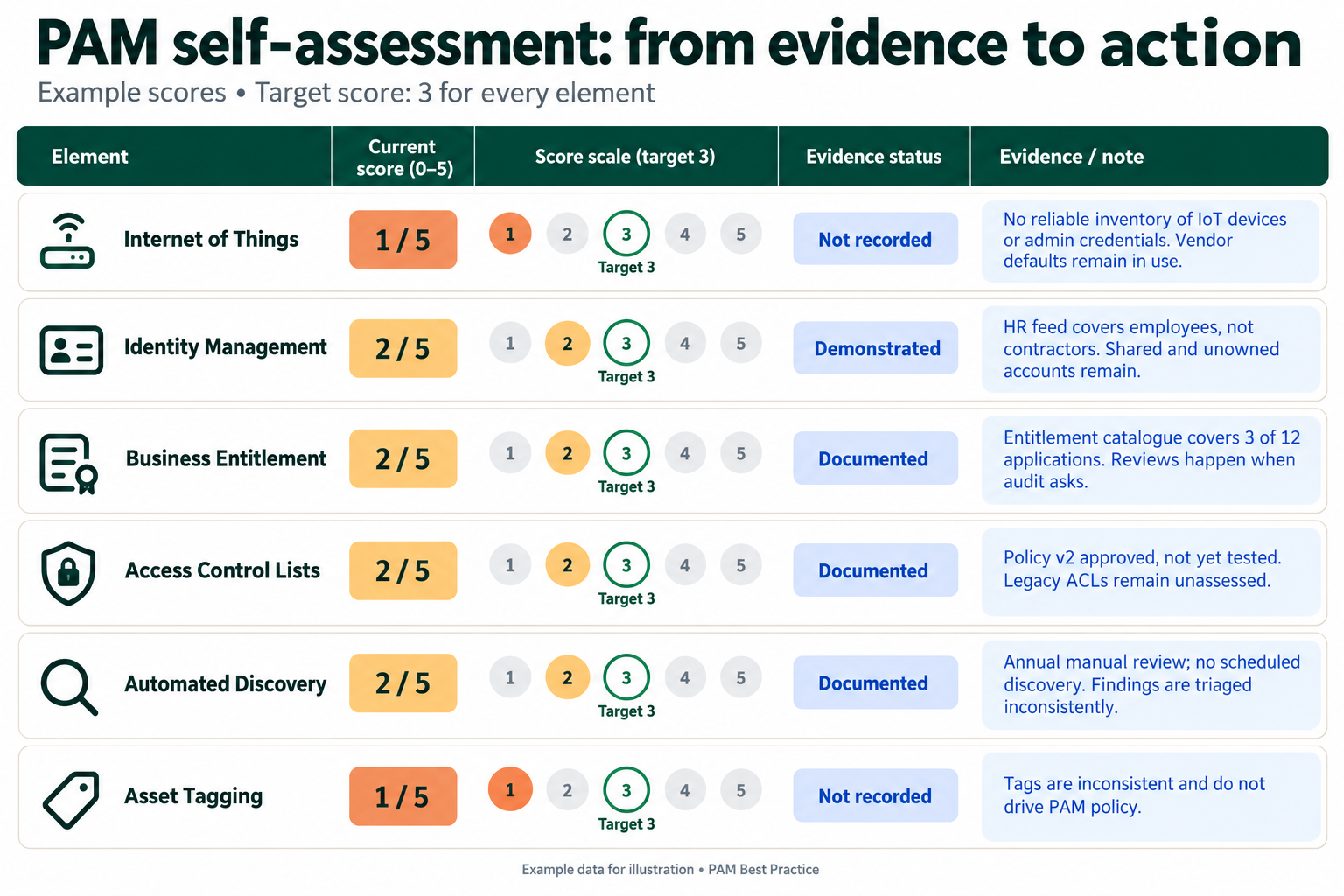
Use the self-assessment to work through those questions with your team, record the evidence behind your answers and agree what to improve first. The Excel workbook and accompanying guide help you structure the review and turn your findings into practical actions.
Select the image to enlarge.
What you will check
The questions are about what happens in practice, not what the policy says. For example:
- Do leavers lose privileged access on their last day? Can you show it for the last five people who left?
- When was the break-glass account last used or tested, and who reviewed what happened?
- How many service accounts does discovery find, compared with the number you thought you had?
- Who approves access to domain admin, and is there a record of each approval?
- Could you show what an administrator did on a critical server last Tuesday?
- Which routes to privileged access still go around the PAM platform?
For each area you score where you are today, note the evidence, and set a target. Each score comes with a plain description of what it means and what the next level looks like.
Select the image to enlarge.
Higher scores need evidence
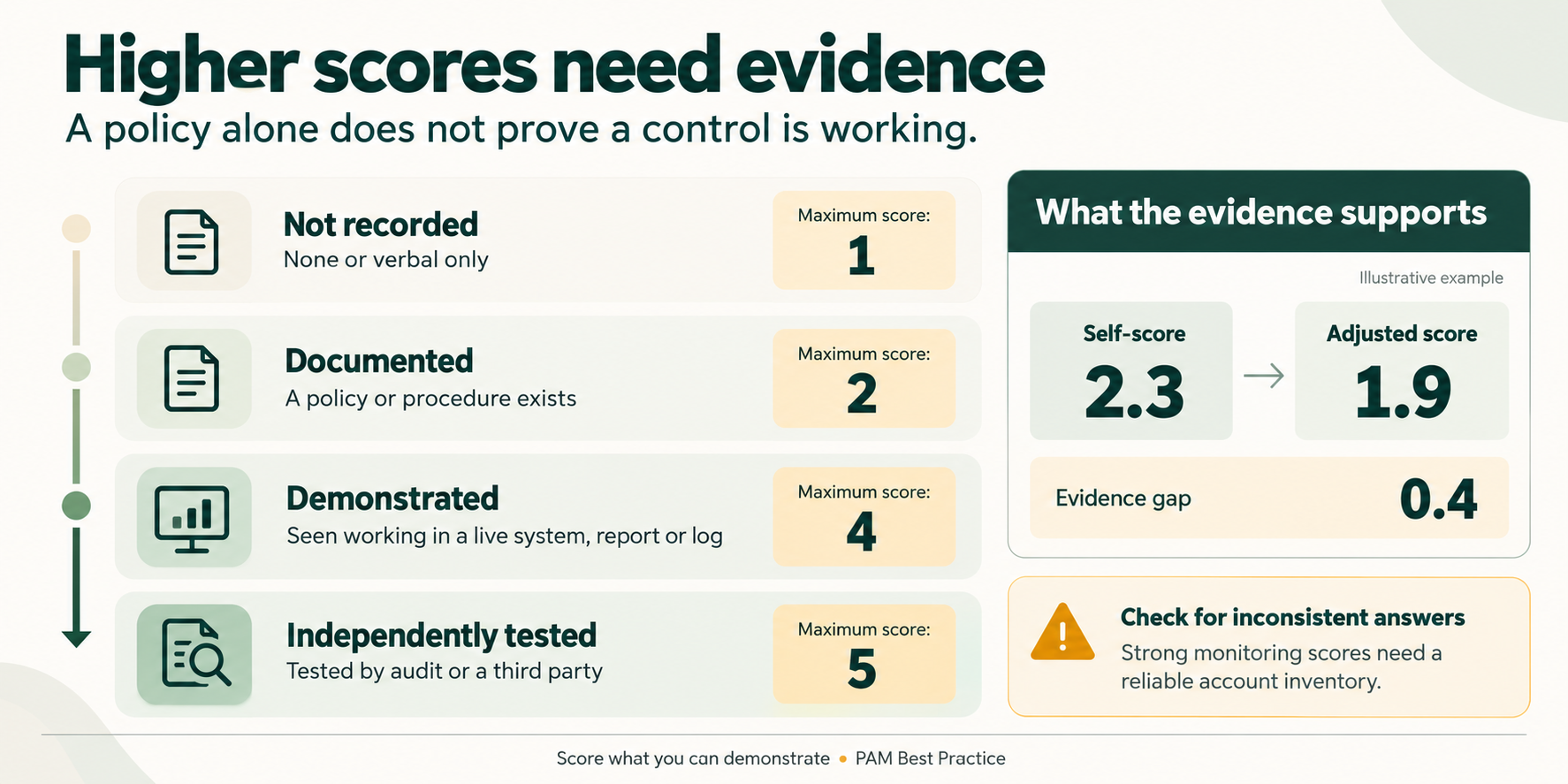
A policy alone does not prove a control is working, so the workbook limits each score by what you can show. A documented procedure caps the score at 2; to go higher you need to see the control working, or have it tested independently.
The dashboard shows the score you gave yourself and the score your evidence supports. The difference is often the most useful finding of the whole review.
The workbook also flags answers that do not add up, for example strong monitoring scores alongside an incomplete account inventory.
Select the image to enlarge.
How to run it
Gather the right people, work through the questions and record evidence for your answers. That usually means the PAM lead plus whoever really knows each area: infrastructure, the service desk, HR for leavers, and someone from audit or risk to challenge the answers.
There are ten exercises, each taking one to four hours. When you finish, the workbook gives you:
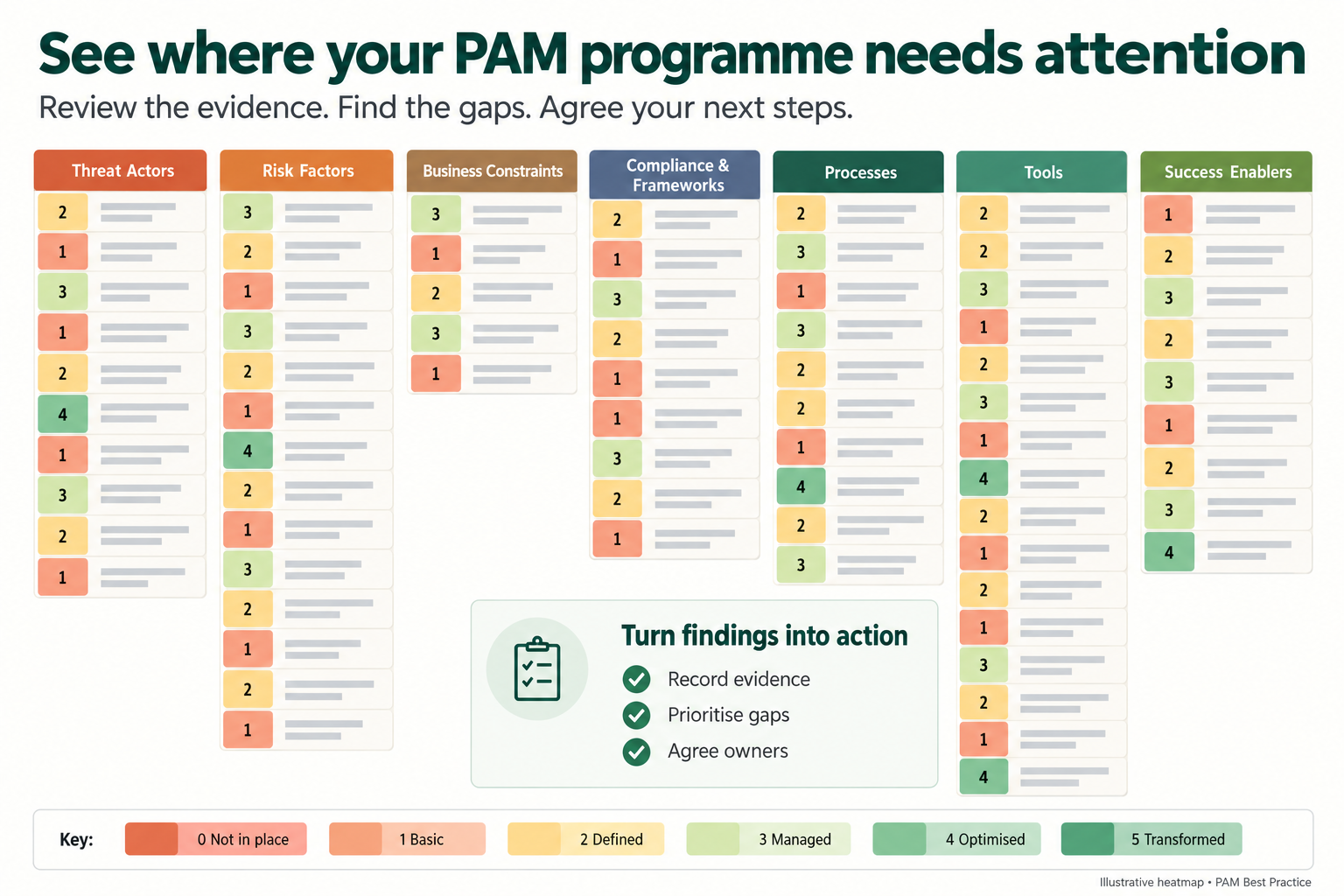
- A heatmap of your programme across the Periodic Table of PAM Security
- Your gaps ranked by risk
- A draft 90-day plan
- A one-page summary for your board or sponsor
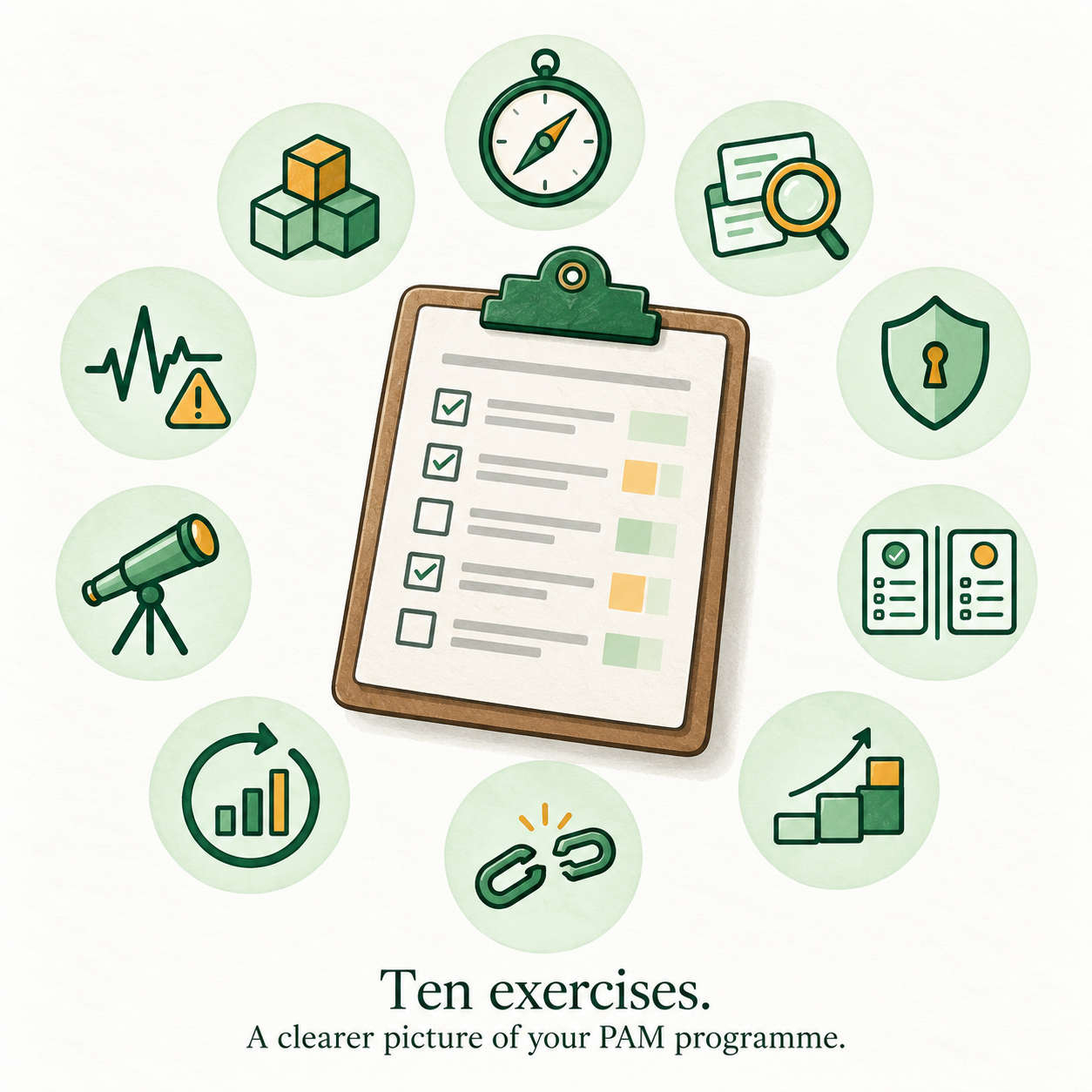
The ten exercises
Each exercise matches a PAM Academy module. Select one to see what it covers and who should take part.
1 PAM Foundations 60 to 90 minutes
Agree which privileged attack routes matter most to you and what they could do to the services you rely on.
Who takes part: PAM or security lead, a business service owner, someone from risk.
Module 1 explains the thinking behind this exercise.
2 Strategy and Operating Model 2 to 3 hours
Check the identity basics PAM depends on, such as joiner, mover and leaver processes, then write down who owns which decisions.
Who takes part: Sponsor for the first hour, PAM lead, IAM lead, HR, a system owner, GRC.
Module 2 explains the thinking behind this exercise.
3 Discovery and Assessment Half a day, plus discovery time
Compare the privileged accounts you think you have with what discovery actually finds, then rank the ten that worry you most.
Who takes part: PAM lead, infrastructure, cloud, directory admins, application owners.
Module 3 explains the thinking behind this exercise.
4 Securing Privileged Access by Risk Half a day
Pick a few real privileged tasks and trace each one step by step: the person, the account they use, the credential, the route they connect through, the rights they get, the system and what they change. Then find the weakest step.
Who takes part: Security architect, infrastructure, network and cloud engineers, service desk.
Module 4 explains the thinking behind this exercise.
5 Choosing a PAM Platform 2 to 3 hours
Whether you are choosing, replacing or reviewing a platform, check that requirements, integration effort and total cost are understood. No products are named.
Who takes part: PAM owner, architect, procurement, finance, integration owners.
Module 5 explains the thinking behind this exercise.
6 Deployment 2 hours
Plan or review the rollout so controls land without a growing list of exemptions.
Who takes part: Programme manager, PAM owner, change manager, service desk lead, communications.
Module 6 is coming soon. The exercise works on its own in the meantime.
7 Monitoring and Incident Response Half a day, including one drill
Check that someone is actually watching privileged activity, and run a short drill to see whether you can respond.
Who takes part: SOC lead, PAM owner, incident response, HR and Legal, internal audit.
Module 7 is coming soon. The exercise works on its own in the meantime.
8 Future-Proofing PAM 2 hours
Look at the fastest-growing part of your privileged estate, usually cloud roles, automation and AI agents, which is often the least protected.
Who takes part: Architect, cloud and DevOps leads, data and AI owners, PAM owner.
Module 8 is coming soon. The exercise works on its own in the meantime.
9 Maturity and Continuous Improvement 2 to 3 hours
Set the baseline you will measure against next time, and record the benefits the programme delivers.
Who takes part: PAM owner, GRC, internal audit, finance, programme manager.
Module 9 is coming soon. The exercise works on its own in the meantime.
10 Why PAM Projects Fail 90 minutes, then the results review
Hold your programme up against ten common reasons PAM projects stall, and check all four kinds of access: people, machines, third parties and emergency access. Then review your results together.
Who takes part: Sponsor, PAM owner, programme manager, a challenger from audit or risk.
Module 10 is coming soon. The exercise works on its own in the meantime.
What is free, and what is not
The self-assessment is free. You get the Excel workbook and the PDF guide, and you can use them inside your organisation as often as you like. The PAM Academy module videos are free too when you register.
The Practitioner Pack is separate and paid. It adds graded module assessments, a certificate of completion and editable programme templates. You do not need it to run this review.
The material names no products and recommends none. Read about our independence.
Get the free self-assessment
Tell us where to send it. We will email you the workbook and the guide.
Common questions
Do I need to take the course first?
No. Someone with PAM experience can run the review straight away. The modules explain the thinking behind each question, so they help if an area is new to you.
How long does it take?
Each exercise takes between one and four hours. Most teams spread the ten over a few weeks rather than doing them in one go.
Can educators use it?
Yes. The exercises work as applied practicals on a real or case-study organisation. For whole cohorts, see training for colleges, universities and teams.