Vendor-Neutral PAM Programme Training: Why Our Approach Works
Learn how people, processes, governance and technology work together to protect privileged access. Our independent, vendor-neutral curriculum helps practitioners and teams develop the knowledge to assess, design, deliver and improve a PAM programme.
What PAM programme training is
Most privileged access management training teaches one thing: how to operate a tool. That matters, but it is only part of the job.
PAM programme training teaches the whole discipline. Why privileged access is targeted, who should own it, how to find it, how to control it in order of risk, how to roll controls out so people adopt them, and how to prove they work.
That is what we mean by a holistic approach. The technology is one part of the picture, and the people, processes and governance around it decide whether a programme succeeds.
Why tools alone are not enough
Take password rotation. Technically, it can work perfectly: credentials change on schedule and nobody knows the current value.
But ask a few questions. Who owns each of those accounts? Who approves access to them, and on what basis? What happens at 2am when the platform is unavailable and someone needs emergency access? Who checks that leavers lose access the same day?
If nobody can answer, the control is working and the programme is not. Those gaps are rarely technical. They sit in ownership, process and governance, and they are where an auditor, or an attacker, will look first.
A PAM programme fails or succeeds on the questions the tool cannot answer.
What you will learn
The PAM Academy has ten modules. Modules 1 to 5 are available now and modules 6 to 10 are coming soon. Across the full course, you will be able to:
- Assess privileged access: find where privileged accounts, credentials and secrets really sit, and what risk they carry. Module 3: Discovery and assessment
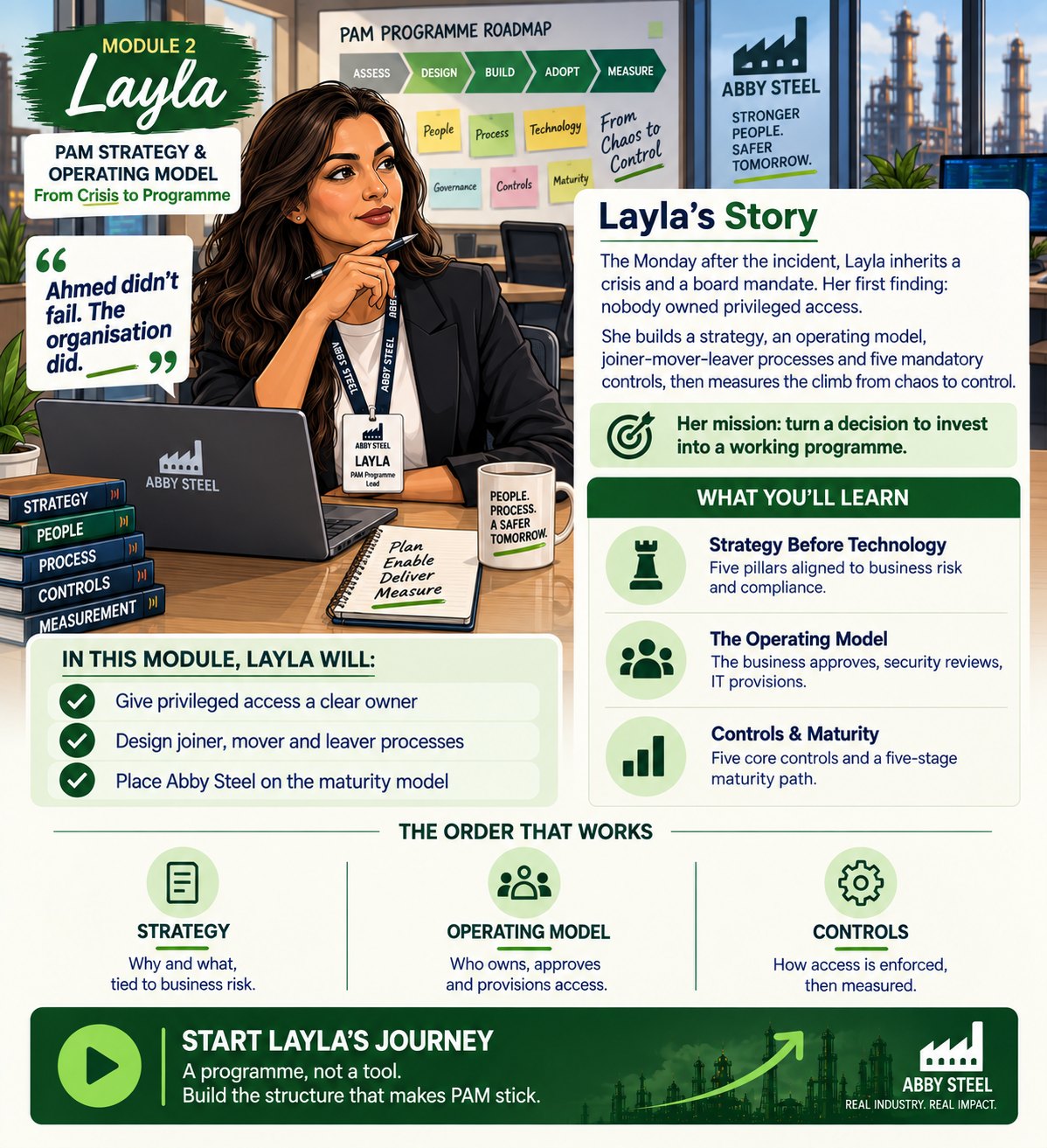
- Define who owns what: set ownership, decision rights and an operating model that survives beyond the project team. Module 2: Strategy and operating model
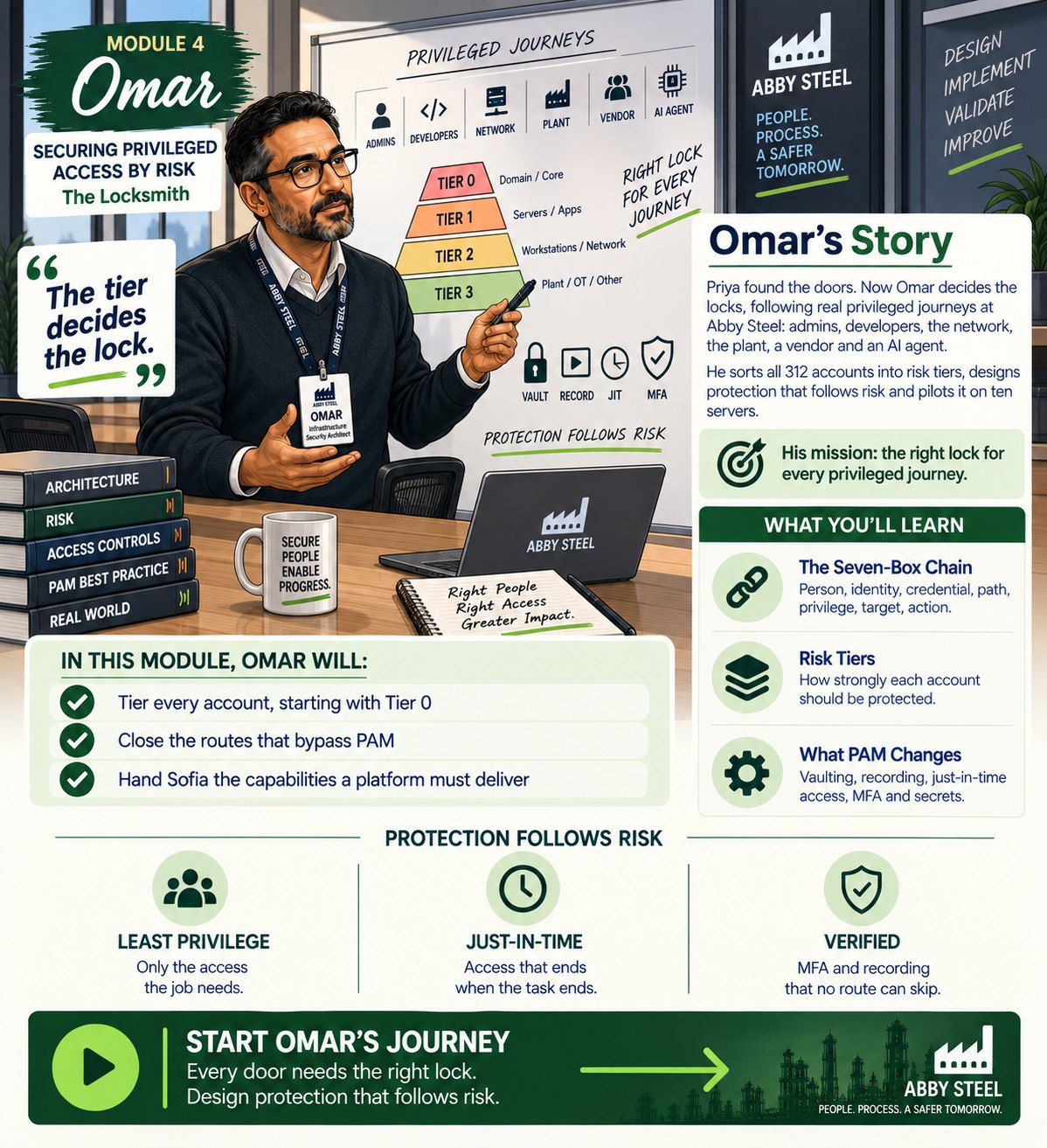
- Design access processes: build request, approval, emergency and leaver processes, and apply controls in order of risk. Module 4: Securing access by risk
- Evaluate and roll out controls: judge capabilities against requirements and sequence a rollout people will adopt. Module 6: PAM deployment (coming soon)
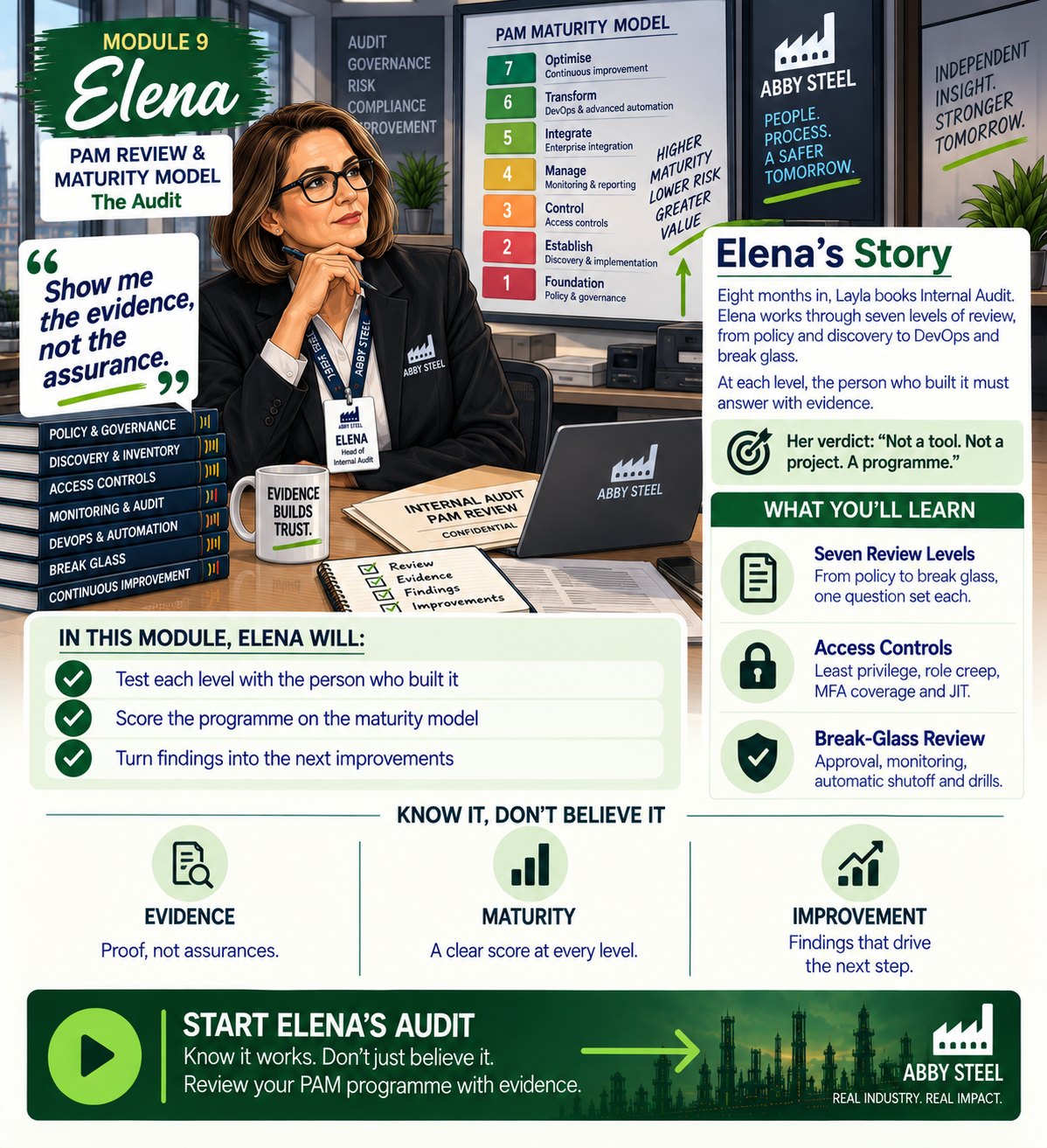
- Measure and improve: monitor privileged activity, produce evidence for an auditor and track maturity over time. Modules 7 and 9: monitoring, review and maturity (coming soon)
Every module ends with a practical exercise you apply to a real or case-study organisation. See the full learning roadmap.
Who the training is for
PAM touches more roles than any single team. The training is written for:
- Implementation and infrastructure engineers who need the programme context around the platform they deploy.
- Security and IAM teams who own privileged access risk and need to explain it to the business.
- Programme owners and managers responsible for scope, sequencing, adoption and reporting.
- Auditors, GRC and risk professionals who need to judge whether controls are designed well and working.
- Students and career changers building a specialist skill on top of a cyber security or computing foundation.
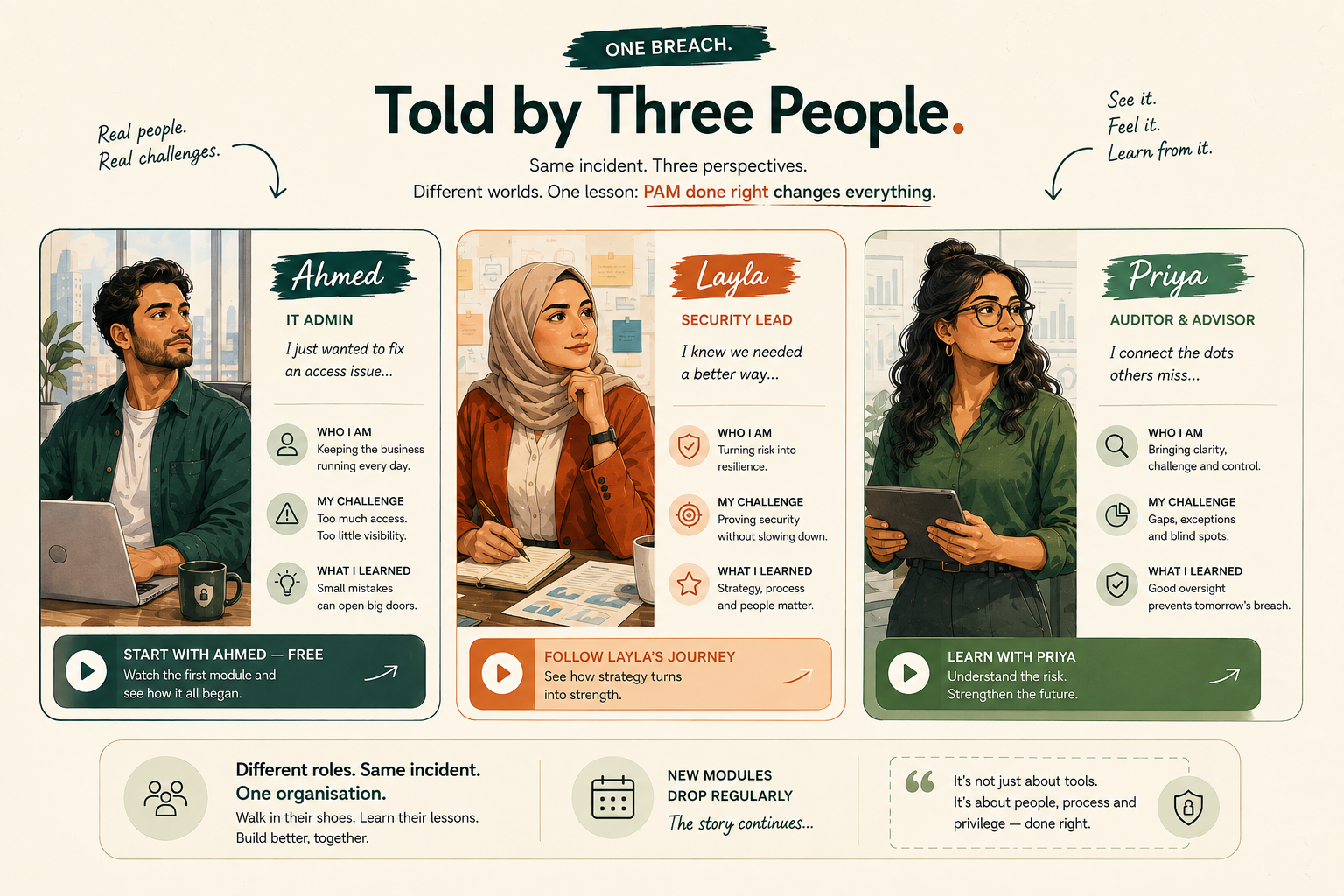
Each module is told by a practitioner in one of these roles, so you see the problem from the seat you sit in.
How the Periodic Table supports learning
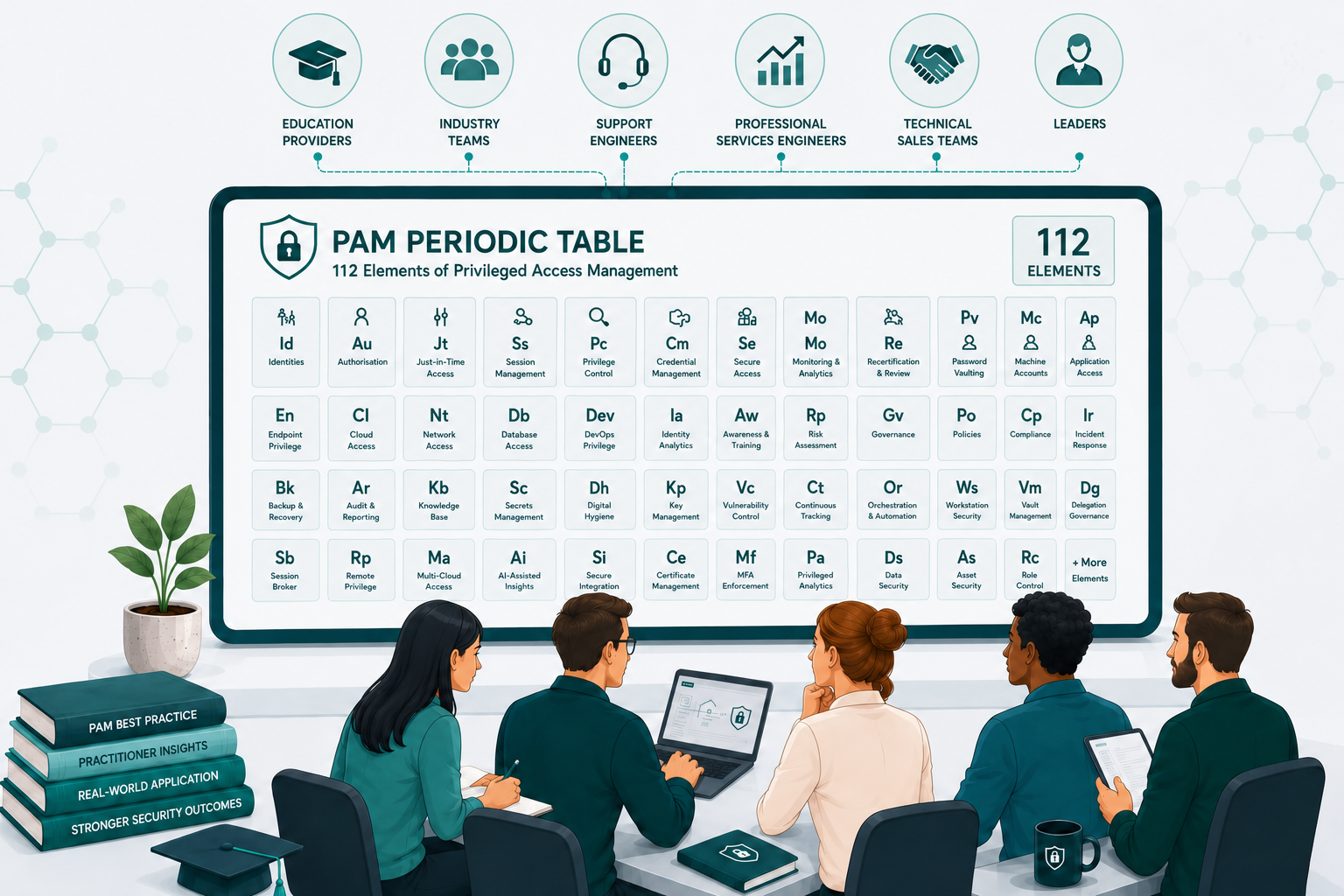
The Periodic Table of PAM Security maps everything a PAM programme has to address: 112 elements across threat actors, risk factors, business constraints, compliance standards, processes, tools and success enablers.
Learners use it as a map. Each module teaches part of the table, so you can see how a topic such as discovery connects to risk, compliance and adoption, and spot the elements your own organisation has not yet covered.
The module exercises together form a free PAM programme self-assessment that scores a programme against every element.
See how we teach before you commit
The curriculum is built from large-scale enterprise PAM implementations, and began as guest lectures at Teesside University. It is practical by design: realistic scenarios, decisions with trade-offs, and exercises you can use at work.
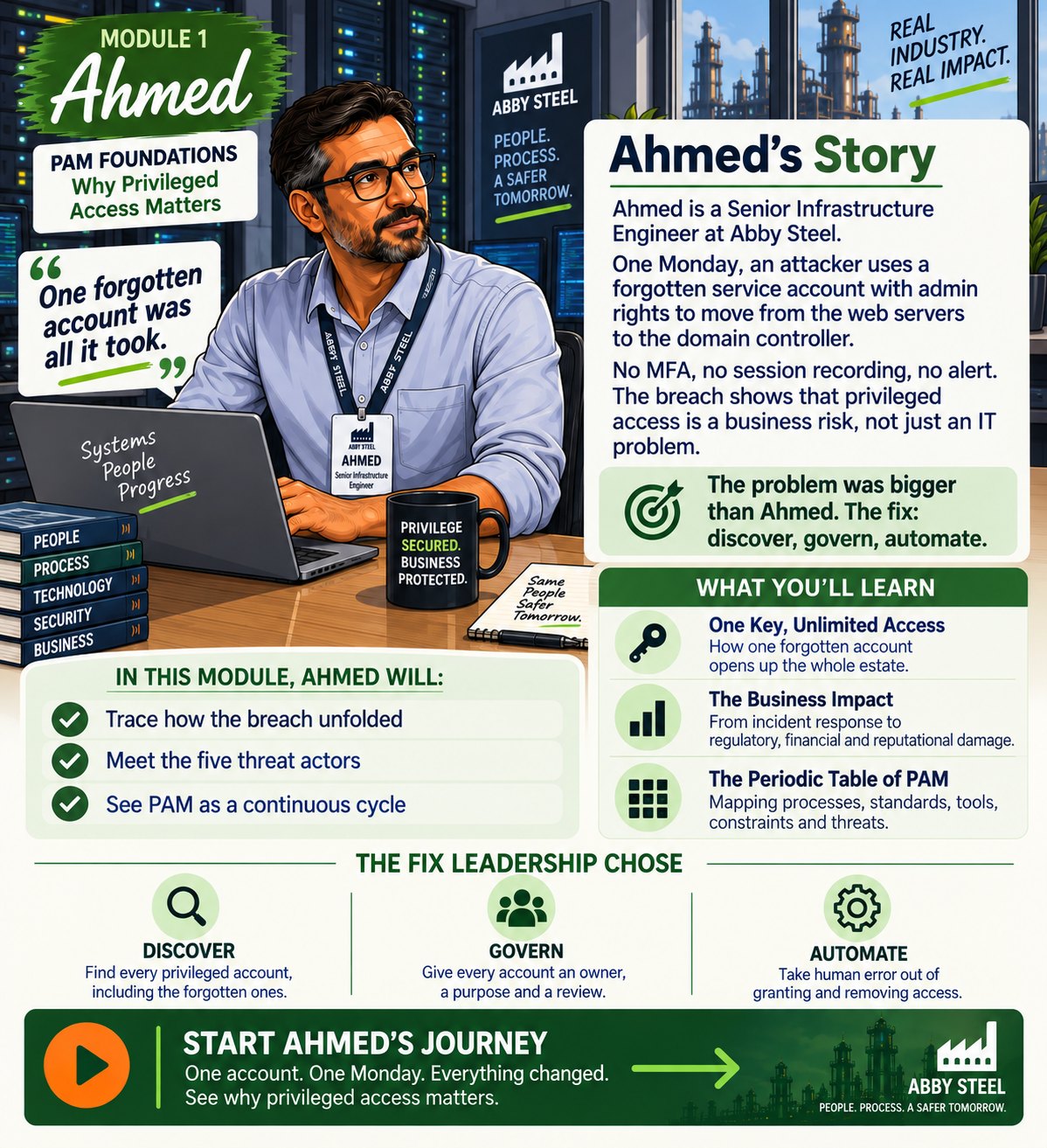
You do not have to take our word for it. Module 1, PAM Foundations is free, and the free self-assessment shows the kind of exercise every module ends with.
Want the background first? Read our guides on PAM governance and PAM roles and responsibilities, or browse the Knowledge Hub.
PAM Best Practice is independent and does not recommend products. Read more about us.
Start learning PAM as a discipline
Explore the PAM Academy Enquire about team trainingCommon questions
Do I need PAM experience to start?
No. Module 1 starts from first principles. Some IT or security background helps, and later modules assume you have worked through the earlier ones.
Is this training on a particular PAM product?
No. It teaches the programme around any product: ownership, discovery, process, risk-based controls, deployment, monitoring and improvement. It works alongside the product training your platform provides.
Can we train a whole team or cohort?
Yes. Teams and institutions can take the modules together. Use the enquiry form and tell us how many people and what you want them to be able to do.
How do I try it?
Start with Module 1, PAM Foundations, which is free.